|
Regional Reviews: Minneapolis/St. Paul Mothership Also see Arty reviews of Kevin Kling: Unraveled and Nina Simone: Four Women and Deanne's review of Pinocchio
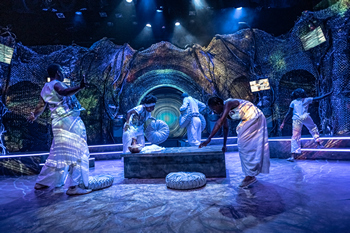
Following the 2020 murder of George Floyd in Minneapolis and the citizen uprisings that followed in the Twin Cities and around the United States, Penumbra took an intentional step to put that healing work front and center, renaming the organization Penumbra Center for Racial Healing. Since then, it has added and bolstered programming in the areas of education for youth and adults, training, leadership development, and community-building, while maintaining a robust theatre performance season. Penumbra's 2026-2027 performance season kicks off with the world premiere of Mothership, co-written by playwright Kristen Adele Calhoun and author and clinical therapist Resmaa Menakem. While Calhoun has a long roster of stage work on her resume, Mothership is Menakem's first foray into playwrighting. He brings to the production his depth of experience, both as a writer, which includes the New York Times best seller "My Grandmother's Hands", and in his clinical practice, guiding individuals and communities through a process of healing from the traumas, whether acquired though life experience or inherited from past generations, of living in a racialized society As might be expected, then, Mothership is about healing and renewal. Set in the future–pessimists among us might say the not-so-distant future–when the Earth has been depleted of the resources needed to sustain human life, causing the decimation of our species with the exception of a small number selected to travel to a new home planet. They are divided into groups of five in space pods that are sentient beings, with the sensibility of a mother who steers her passengers through a process of healing and renewal necessary in order for them to create a robust and sustainable society in their new home. The play takes place over the course of their journey to that new home. We see the arrival of each of the five strangers who will share the voyage through space, arriving without understanding of the project they have been selected for, though they do know that remaining on Earth means certain death. As is common in the dramatic structure of such a premise, the five brought together are a diverse lot, by age, gender, and temperament. Their common denominator is that all five are Black. Some of the travelers are leery of the venture and need to be convinced that it is their only option. The youngest of them, Amina (Juliah Jefferson, the performance I attended), is distraught over being separated from her older brother, though she is assured (without evidence) that he is safe and travelling in another pod, and that she will be reunited with him in their new home. Harper (Ashambaga Jaafaru), who goes by "Harp," is a young adult, full of hip-hop energy and bravado, but still in need of tenderness, as displayed by her attempt to sneak a pet bunny named Mr. Wiggles onto the pod, in defiance of the rules that clearly state travelers may bring "No Food. No Baggage! No Nothing!" Connor (Josh Walker) is a tightly wound man with a military past, threatened by the prospect of exposing his feelings. Evander (Bruce A. Young) is a chaplain and an elder, which one might expect put him at ease with shedding the thick skin acquired through exposure to trauma and re-create himself. But he is unwilling to give his status, whatever the greater good. Nikki (Zuhairah) is the fifth traveler. Like Evander, she is an elder, but unlike him, she draws joy and hope from her years of experience–she is not naïve and has endured hardship, but she recognizes joy and hope as weapons for change, giving her a leg up over the others on what they will experience. The five travelers are continuously challenged, as when they learn that the fine repast they are enjoying will be their only meal during the journey. As they learn more about one another, they shift from being strangers to fellow-travelers. The omnipresent voice of the Mothership, guides them gently, though certain rules are inviolable. In those instances, the soothing voice of Mother is replaced by a harsh, robotic voice that brooks no dissent. Both are authoritatively given voice (offstage) by Ibimina Dominique Thompson. In the end, all five travelers must willfully give up who they were in order to discover what they can become. For the planet that awaits them to offer a new, creative existence as a community drawn on the roots of their Blackness, there can be no dissension, and all must embrace change or accept that their only alternative to change is death. Menakem and Calhoun have created an interesting saga, laden with messages about how to free ourselves and support one another to embrace change. The theme of healing from the acquired traumas of life on Earth is interlaced throughout, as is the idea that digging down to inherent Blackness will furnish each with a strong, uplifting core to build upon. The process, though, of getting through that journey is rather clumsy and episodic in its delivery, and sometimes lacks enough backstory to fully make sense of a character's behavior or how a given scene contributes to the eventual outcome. Even so, the conclusion makes it clear what has been accomplished by taking this journey and giving way to a fresh start, rooted in Black identity. It stretches credibility that the characters, at the onset, are not more freaked out by their circumstances. Even though they are being given a chance to start a new society built upon the essence of Blackness, the knowledge that everyone not so fortunate will die and that life as they have known it will vaporize, would be a serious trauma in itself, far more than is exhibited in Mothership. Dramatic license has held sway in order to tell the story at hand, but one can imagine a longer piece that takes time to address the trauma of that loss before entering the process of transformation. This might provide a foundation that more clearly illuminates each character's narrative arc. Even without such a foundation, Candis C. Jones, a New York-based director, deftly steers the actors through the distress and discoveries of their voyage, bridging gaps in the narration to foster understanding each character's transition. The actors, as one has come to expect at Penumbra, each excel in their roles. Jaafaru conveys Harper's deep well of energy and capacity for empathy, and also delivers much of the humor imbedded in the play. Walker's depiction of the significant transformation experienced by Captain Connor is particularly moving, while Young firmly expresses the stone resolve that causes Evander to view change as a failure, particularly as a male. As Amina, Jefferson (an impressive 12-year-old actor double-cast in the role with Michelle Kanyugi) believably depicts her fears and insecurity, while summoning the courage that lies within her heart. Zuhairah brings strength, conviction, and warmth to her portrayal of Nikki, though I could have used a few fewer knee slaps accompanied by a burst of laughter. If the play feels a little disjointed, the physical production is a marvelous, unified achievement. The stunning set designed by Chelsea M. Warren inventively creates the Mothership's interior, with the cosmos beyond visible by way of Miko Simmons' adroit projections, all heightened by Brandon Wardell's lighting design and Jeff Bailey's sound design. Azalea Fairley's costumes provide a visual album of the characters' transitions from individuals to a community with common goals and allegiances, and finally to a synthesis of community identity with blossoming individualities. Mothership repeatedly references the empowering effect of a return to essential Blackness. It does not, at least that I detected, demonize or call to act against whiteness–it merely leaves white society out of the equation. As a narrative that depicts the jettisoning of all that is toxic, experiences healing of the traumas encumbered in the past, and suggests what a new, empowered re-start might look like, it succeeds, in the manner of a fable painted with broad strokes but able to wrap up with a moral, as all good fables do. Mothership runs through October 4, 2026, at Penumbra Theatre, 270 North Kent Street, Saint Paul MN. For tickets and information, please visit www.penumbratheatre.org or call 651-224-2025 -3180. Playwright: Resmaa Menakem & Kristen Adele Calhoun; Director: Candis C. Jones; Set Designer: Chelsea M. Warren; Associate Set Designer: Sebastian Zavalza; Costume Designer: Azalea Fairley; Assistant Costume Designer: Jocelyn Reed; Sound Designer: Jeff Bailey; Lighting Designer: Brandon Wardell; Props Designer: Jenny Moeller; Projections Designer: Miko Simmons; Video Programmer: Bevibel Harvey; Wigs and Makeup Designer: Jamakah Webb; Production Manager: Antonia De La Vega; Stage Manager: Ajah Williams; Assistant Stage Manager: Alexis Willcox. Cast: Ashambaga "Ashe" Jaafaru (Harper), Juliah Jefferson * (Amina Gladwin), Michelle Kanyugi * (Amina Gladwin), Ibimina Dominique Thompson (The Ship/Glitchster), Josh Walker (Captain Connor Medley), Bruce Young (Chaplain Evander Worthington), Zuhairah (Aunty Nikki Drummond). *alternate performances |