|
Regional Reviews: Minneapolis/St. Paul Waiting for Godot Also see Arty's reviews of Head Over Heels, Fancy Dancer, Mamma Mia!, and Mothership and Deanne's review of Indecent
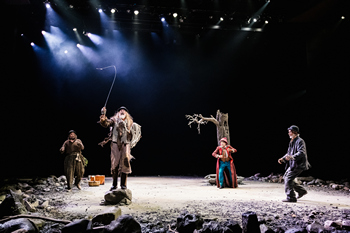
Samuel Beckett's play Waiting for Godot is generally acclaimed as a masterpiece. In a public poll conducted in 1998 by London's Royal National Theatre, Waiting for Godot was voted "the most significant English language play of the 20th century." It is frequently revived by regional theatre companies world-wide, which makes it surprising that, until now, the Guthrie had not staged Waiting for Godot since 1973. Of course, Bill Irwin's exhilarating one-man show, On Beckett, included generous tidbits of Godot when it visited the Guthrie in the winter of 2024. And so I now say, hurrah! The play has been mounted at the Guthrie in a sweeping, articulate, thought-provoking, and highly entertaining production on the Wurtele Thrust Stage. Directed by the Guthrie's Artistic Director Joseph Haj, every element–pacing, staging, design, and acting–has been honed to a sharp edge to make this as excellent a production of Waiting for Godot as you are likely to see anywhere, and reenforces the play's stature in the pantheon of works for the stage. It must be stated that the play is extremely funny and Haj, while not gliding over substance, allows all of its dark humor to bubble up. All that praise for a play in which, famously, nothing happens? Really? Well, hold on. True, nothing happens in the form of a narrative thrust, where things start at point A, progress through B, C, and D, and conclude at point E. Act One opens as two characters, Estragon (Jimmy Kieffer) and Vladimir (David Strathairn), a pair of ragged looking, down on their luck souls, meet at the start of day in a desolate space with one tree, one log, and one stone. They exchange thoughts and pleasantries, while waiting for the enigmatic Godot, who seems to have the capacity to alter their lives. Their most exceptional event all day is an encounter with Pozzo (William Sturdivant), whose arrogance is made visible by his extravagant attire, and the ironically named Lucky (Jim Lichtscheidl), who is even more ragged than Vladimir and Estragon, and whom Pozzo controls by barking sharp commands and by tugging on a thick rope tied in a loop around Lucky's neck. Otherwise, the day passes with Estragon picking at the scabs on his feet, bemoaning his fate, and suggesting he and Vladimir might each be better off on their own, and Vladimir trying to maintain a "glass half full attitude" and keeping his buddy's spirits from drowning. Estragon often sits–on the rock, on the log, on the ground leaning against the tree–while Vladimir almost always stands, alertly on psychic as well as physical duty. Nothing changes, yet the interaction between these two, who evidently have a long history as friends, perhaps even a family tie, is not nothing. Note, for example, the pet names they have for each other, Didi and Gogo. Waiting for Godot attests to the mysterious way in which two people connect, each giving the other a reason not to collapse under the weight of existential despair. Pozzo and Lucky, who appear to be master and slave, abuser and victim, have their own dynamic in which each, we see, needs the other, not only for an exchange of benefits–Lucky doing all of Pozzo's work, Pozzo providing Lucky with a meager sustenance–but in marking out their places in the game of life. Lucky may be miserable, but his misery gives his life meaning. He understands what he is to do, however loathsome that may be. And Pozzo knows his role, to be Lucky's master–which, perhaps, is why, in spite of saying he plans to sell Lucky at the market, it has not yet happened. Godot, if and when he arrives, might deliver purpose to Estragon and Vladimir, or might not. Godot is a possibility, but what they have with certainty is each other. In the face of the stark world around them, that is a great bounty. They are each other's hope, far more tangibly than that offered by the Godot they never have seen, who may or may not ever come, and who may or may not even exist. Their memories are faulty, so that the past can never be relied upon, only their time together is the moment provides them with solid ground. Haj has brought a cast of top pedigree actors to animate Beckett's characters. Strathairn, a veteran actor known for work on stage and in film, makes a marvelous Guthrie debut as Vladimir. His Vladimir bears the burden of his impulse to do the right thing–to buoy his friend's sagging spirits, to protest Pozzo's treatment of Lucky, to believe that coming back tomorrow is preferable to giving up. It is a burden that wears on him, but Strathairn conveys the sense of purpose it gives him. Kieffer's sad-sack Estragon is an ideal match, the two actors breathing life not only into the characters, but into the friendship that sustains them both. Kieffer's Estragon is a wonderful grouch, while he stealthily conveys his affection for Vladimir. They also do a lovely job with comic business involving the bowler hats each wear, reminiscent of Laurel and Hardy. Sturdivant is terrific at dishing out Pozzo's bombast, while taking forays into piques of despair over the smallest slight. Sturdivant has excelled in Shakespearean roles, including at the Guthrie and as a company member at Great River Shakespeare Festival. Here he marries the gravitas of a Shakespearean royal with the high-strung nerves of a diva. Lichtscheidl is a master of physical comedy, which he puts to good use here as Lucky. In Lucky's one ginormous word-salad of a monologue, a tsunami of physical and verbal tics produces an astonishing sequence that won't soon be forgotten. As Godot's young messenger, Antonio Teodoro conveys an innocence and purity, along with the subtlest of hints that he may know more than he is willing–or permitted–to say. While the requirements of staging Waiting for Godot allow it to be done on a much smaller stage (the first Godot I saw, in the early 1970s, was on a pocket-sized stage in Off-Broadway's Sheridan Square Playhouse), the set for the current production has been brilliantly designed by Marion Williams to take up the broad expanse of the Wurtele Thrust, rimmed with a dusty perimeter of gravel, stone, and dirt. This emphasize how vast and desolate Estragon and Vladimir's world is and how starkly alone they are, but for each other. Christopher Akerlind's lighting design provides a receding gray sky that gradually draws the curtain on daylight as the sun recedes. Trevor Bowen's costumes make fine distinctions among Vladimir's, Estragon's, and Lucky's levels of fallen grace, while Pozzo's marvelously gaudy outfit affirms the boorishness of his class. As movement director, Carl Flink may be applauded for devising a wild dance Lucky performs something like a marionette whose strings got crossed with an electric circuit. The "play about nothing" actually has a lot to say about how we endure the indignities and uncertainties of life, and how levels of control rise among people. The story is not in what happens, but in what transpires between these characters, and how that enables them to wait for the arrival of meaning, unaware that perhaps the meaning comes from the waiting itself. Or not; your take on what Beckett the play says to us may be very different from mine. Either way, Haj's production of Waiting for Godot will give you plenty to ponder amid exceptional artistry and high caliber entertainment. Waiting for Godot runs through October 11, 2026, at the Guthrie Theater, Wurtele Thrust Stage, 618 South 2nd Street, Minneapolis MN. For tickets and information, please call 612-377-2224 or visit GuthrieTheater.org. Playwright: Samuel Beckett; Director: Joseph Haj; Scenic Designer: Marion Williams; Costume Designer: Trevor Bowen; Lighting Designer: Christopher Akerlind; Sound Designer: Darron L. West; Movement Director: Carl Flink; Fight Director: Annie Enneking; Resident Dramaturg: Carla Steen; Vocal Coach: Sara Becker; Resident Casting Director: Jennifer Liestman, C,S,A; NYC Casting Consultant: McCorkle Casting, Ltd; Assistant Director: Connor Berkompas; Stage Manager: Karl Alphonso; Assistant Stage Manager: Jason Clusman. Cast: Jimmy Kieffer (Estragon), Jim Lichtscheidl (Lucky), David Strathairn (Vladimir), William Sturdivant (Pozzo), Antonio Teodoro (A Boy). |