|
Regional Reviews: Minneapolis/St. Paul The Hired Man Also see Arty's reviews of Wife of a Salesman, Waiting for Godot and Head Over Heels
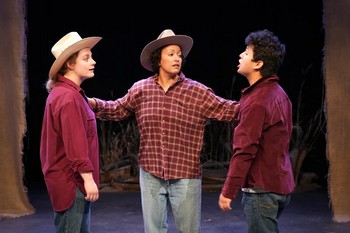
The Hired Man takes place in present-day Wyoming, a setting that conjures up images of rugged individuals living their lives spread apart by cattle ranches that test their ability to subdue the natural elements. One such man is Hank, who runs a cattle ranch by the force of his own two hands, his hired man Tim, and the 17-year-old granddaughter, Ellen, he has raised since her grandmother showed up and shocked him with the child 14 or 15 years ago. Some back-story: Ellen's grandmother and Hank had a tryst 37 or so years before. It didn't amount to much between them, but resulted in a baby girl. Hank had gone his own way, and the woman raised their child on her own, with Hank totally unaware that he had fathered a daughter. That daughter got pregnant at a young age and had a child of her own, which she was unprepared to care for. She left her baby with her mother and disappeared from their lives. When Ellen's grandmother received a terminal cancer diagnosis, she managed to track Hank down, fill him in on what had transpired, and leave Ellen in his care. Ellen's grandmother died not long after, so Hank is her only family. Ellen has grown up around ranch work and prides herself on being able to hold her own against Tim, who, is only six or seven years her senior. Hank had taken a shine to Tim, calling him "the son I'd never had." That fondness comes to a crashing end when Hank catches Tim and Ellen having sex. In fact, it was Ellen who had provoked sexual relations with Tim. To her it was just a lark, but Tim has tender feelings for Ellen and talks about them having a life together, a notion she rejects. To Hank this makes no difference and he violently ejects Tim from the ranch and from their lives. Tim remains intent on fighting for his place at the ranch and in Ellen's life. In need of a new hired man, Hank heads to town and meets Mattie, a woman with as much know-how and confidence around ranch work as any man. Despite some gaps in her background, Hank hires her, relying mainly on instinct. Mattie is a tough, but not unkind, customer. Though wearing rancher's garb with no pretense of harboring feminine wiles, Hank is clearly drawn to her. This is a problem for Georgette, Hank's girlfriend of five years, cast in a much more traditionally feminine light. She makes no secret of her desire for Hank to marry her. Mattie also becomes a role model for Ellen, who admires Mattie's competence and tough edge, and seems determined to win Mattie's favor. One other character has a haunting presence in the play. This is Linda, a woman older than Mattie, similarly attired and even tougher, who lives in Mattie's memories. Linda taunts Mattie for running away and insists that no matter how much Mattie runs, she–Linda–will always be with her. The director's notes refer to The Hired Man as a queer story, and their conversations convey a deep, if fraught, intimacy so I took Linda to be Mattie's former lover, alive in her memory. Perhaps you will as well. But pay attention as the play unspools. That unspooling becomes increasingly intense in the play's second act, leading to a tragic ending, with overtones of the Greeks. We are reminded that trying to outrun our fate is a losing proposition, and that facing the truth about who we are on what we have done is the surest way, ultimately, to stave off grief. If only that lesson were as easily learned in life as on stage. Director Jennie Ward has created a noirish atmosphere that hints of an impending fall from grace right from the beginning. It is the sense of seeing an accident about to happened down the road and being unable to prevent it. Individual scenes are staged to heighten the tension in the air, such as when Hank, Mattie, and Ellen work together to inoculate young cattle in the field. Fight and intimacy choreographer Annie Enneking, a seasoned pro, does especially fine work in both domains, bringing authenticity to the fore. Jessica Winingham is outstanding as Mattie, a "hired man" who happens to be a woman, and whose competence and overriding good nature can't hide the fact that she is on the run from life. Andy Chambers gives a strong performance as Hank, believable in his over-protectiveness toward Ellen, his irrational outburst against Tim, his coyness toward Georgette, and confused emotions he harbors toward Mattie that he, finally, cannot contain. Bee Davis makes a powerful impression as Ellen, a young woman with a strong sense of herself in rebellion against what the world expects. Exemplifying this is her appearance in a red prom dress, agonizingly uncomfortable by the very thought not only of the dress, but of prom, or when Mattie tells Ellen, "You have a lot of confidence," and Ellen's reply is a flinty "I get what I want." Wini Froelich is a compelling presence as Linda, wreaking havoc with Mattie's equilibrium. As Georgette, Jenny Ramirez conveys the fraying patience of a woman who wants to believe that she has a chance at settled-down happiness despite the signs that, at least with this man, it's not about to happen. Phi Hamens Nelson similarly conveys Tim's desire for a settled life with Ellen early on, before we see his descent into feeling hurt, abused, and finally lashing out in fury. My only quibble is that Nelson seems too young for the role, more of a hired boy than a hired man. Tech credits for this production are top drawer, especially the sound (by Topher Pirkl) and lighting (by Lily Petit) design, which produce a frightful storm effect and modulate the emotional tenor from scene to scene. MJ Leffler's spare set design serves the production well, and Barb Portinga's costume designs accentuate the inner nature of each character through the clothes they wear, and make sure we know they are in Wyoming, with plenty of cowboy hats to go around. The Hired Hand is a layered play that gives its audience much to think about. While the plot has several questionable devices and unresolved puzzles. For example, how did Ellen's grandmother track down Hank, and why did Hank, a childless bachelor for all these years, agree to take in Ellen? Why does Hank hire Mattie, even when she admits that she fell into trouble with her last employer, and cannot provide references? Sometimes all of this feels like a "set up," rather than a naturally evolving narrative. And yet, taking that narrative at face value, it carries us on a riveting journey across a host of conflicting emotions: desire, affection, pride, shame, elation, and defeat. This sharp production will leave you with much to ponder. The Hired Man, a Theatre Pro Rata production, runs through October 10, 2026, at the Crane Theatre, 2303 Kennedy St. NE, Minneapolis MN. For tickets and information, please visit www.theatreprorata.org. Playwright: Heather Meyer; Director: Jennie Ward; Set Design: MJ Leffler; Costume Designer: Barb Portinga; Lighting Design: Lily Petit; Sound Designer: Topher Pirkl; Props Designer: Jenny Moeller; Intimacy and Fight Choreography: Annie Enneking; Stage Manager: Clara Costello; Production Manager: Emmet Kowler. Cast: Andy Chambers (Hank), Bee Davis (Ellen), Wini Froelich (Linda), Phi Hamens Nelson (Tim), Jenny Ramirez (Georgette), Jessica Winingham (Matty). |