|
Regional Reviews: Minneapolis/St. Paul You're a Good Man, Charlie Brown Also see Arty's review of Mystic Pizza
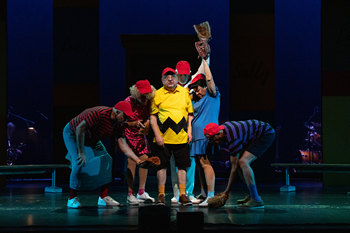
If the show is, itself, a modest joy, Artistry's production lifts it off the ground with terrific staging by director-choreographer Kelli Foster Warder, and splendid performances by some of the Twin Cities' most accomplished musical theatre actors. This is You're a Good Man, Charlie Brown at its peak. The comic strip "Peanuts" first appeared in syndication in 1950, after starting life under the title "Li'l Folks" in the St. Paul Pioneer Press, a point of pride for our local readers. By the mid 1960s, Peanuts had already become a national cultural touchstone, appearing in over one thousand newspapers, with best-selling paperback collections of the strips and a series of darling inspirational books beginning with "Happiness Is a Warm Puppy," the puppy being Charlie Brown's pet beagle, Snoopy. Two animated holiday television specials, "A Charlie Brown Christmas" (1965) and "It's the Great Pumpkin, Charlie Brown" (1966) were aired–and continue to be seen during their respective holiday seasons to this day–before the Peanuts gang finally made it to the stage, almost 60 years ago. You're a Good Man, Charlie Brown first appeared as an off-Broadway musical in 1967. Clark Gesner created a collection of songs (both music and lyrics), and vignettes were developed by Gesner with input from the original creative team, based on the comic strip's primary characters, their distinctive personalities, and some of its best-known running storylines. The show had some new music and lyrics (by Andrew Lippa) and dialogue (by Michael Mayer) inserted into a 1999 Broadway revival, which is the version mounted by Artistry. At the center is Charlie Brown, whose gullibility, yearning for approval, lack of self-confidence, and dorky clothes create what has been called a "Charlie Brown personality." He is joined by his loyal, optimistic, and precociously philosophical best friend Linus; Linus' bossy big sister Lucy, a narcissist who can't help herself from humiliating Charlie Brown; and Schroeder, a Beethoven-loving prodigy whom Lucy plans on marrying someday, though he barely tolerates her. The original 1967 show had a character named Patty, who was Lucy's friend in the strip, but this "slot" was replaced in the 1999 revival by Sally, Charlie Brown's younger sister, who cluelessly tries to make sense of the world and inevitably settles on wrong conclusions. Finally, there is Snoopy, Charlie Brown's independent-minded dog, a singular beagle who is extraordinarily expressive and imaginative. The opening title number–originally a frisky march, though in this production, it is given a jazz tempo that creates an edgy feel–introduces the characters with a series of non sequiturs. The show continues with storylines about Charlie Brown's search for confidence and affirmation, specifically regarding his hopeless crush on a little red-haired girl, his inability to fly a kite, and his failure to manage his little league team to victory. When one of the kids suggests that maybe he should just be a "bench manager," guileless Sally adds, "you could decide where to put the bench." Also on tap is the continuing saga of Lucy's unrequited adoration for Schroeder and Schroeder's equally intense adoration for Beethoven ("Schroeder," "Beethoven Day"), Lucy's penchant for humiliating Charlie Brown ("The Doctor Is In"), Linus's attachment to the security blanket he totes around while spouting words of wisdom ("My Blanket and Me"), Sally's efforts to pare down life into terms she can understand ("My Philosophy"), and Snoopy's flights of imagination, especially in two especially grand numbers, "The Red Baron" and "Suppertime." The full ensemble endearingly presents a spectrum of approaches to the challenge of producing a book report on that daunting literary classic, "The Tale of Peter Rabbit." Jay Albright has the title role as Charlie Brown. Albright's hangdog performance beautifully summons the sensitive and awkward little boy with a sense of his life being a morass in which he struggles mightily to find rays of hope. Bradley Greenwald may be having the best time as Snoopy, embedding this beloved dog with the imaginative spirit of a child. He certainly has the best of the numbers, giving tour de force delivery to both "The Red Baron" and "Suppertime." Tod Peterson, as Linus, comes closest to capturing the physical bearing of a young child, and manages to seem natural sucking his thumb and clinging to his blanket while simultaneously making brilliant observations. Michele Barber conveys Sally's feisty spirit as she confronts the world head on, even if it makes no sense to her. Barber channels Sally's nervous energy with aplomb, and makes the caustic "My Philosophy" a standout number. As Lucy, Jen Santoro Rotty, recently seen at Artistry as Abuela Claudia in In the Heights, makes a terrific swivel to a totally different character. A vignette in which Lucy conducts a poll to learn how others perceive her is a comic gem. Joenathan Thomas has a gorgeous voice, put to good use as Schroeder throughout the show, and especially leading the company in "Beethoven Day." However, he doesn't seem to immerse himself into a child's world view, delivering Schroeder's lines without conjuring the essence of a child. Sanford Moore conducts the band that brings a jaunty flair to Gesner's and Lippa's mainly playful score. The exception to playfulness is the sweetly yearning final number, "Happiness," likely inspired by those once ubiquitous "Happiness Is..." books. It is a beautiful way to end the show, bringing the children, with their foibles, fears, and misguided understandings of the world, together as a community. The set for this production is very spare–there is no credit given for set designer–but effective. Jim Eischen's lighting design, C. Andrew Mayer's sound design, and costumes coordinated by Britt Hilton all enhance the show without overwhelming its simple structure. I grew up in the 1950s, spending my childhood with Charlie Brown and the Peanuts gang, who did not grow up but remain forever as young children, experiencing the world with fresh eyes. By the time You're a Good Man, Charlie Brown opened, I was a teenager, but I still appreciated those children whose naïve yet sage reflections on life somehow eased the thorny path into adulthood. I bought the show's original cast album and played it over and over, along with the Beatles, the Doors, and the Smothers Brothers. All of them seemed to fit together like pieces of a jigsaw puzzle that gave clues to the life that awaited me. Which leads me to say that, while You're a Good Man, Charlie Brown is a show children can easily enjoy and is a safe bet for anyone seeking family entertainment, it feels meant at least as much, if not more so, for adult audiences, to gently redirect us to look back on the ways in which, many years ago, we encountered the world, and to once again see and evaluate it with fresh eyes. You're a Good Man, Charlie Brown runs through October 25, 2026, at Artistry, Bloomington Center for the Arts, 1800 West Old Shakopee Road, Bloomington MN. For tickets and information, please call 952-563-8375 or visit artistrymn.org. Book, Music and Lyrics: Clark Gesner, based on the comic strip "Peanuts" by Charles M. Schulz; Additional Dialogue: Michael Mayer; Additional Music and Lyrics: Andrew Lippa; Director and Choreographer: Kelli Foster Warder; Associate Director: James Detmar; Music Director and Orchestration: Jason Hansen; Conductor: Sanford Moore; Costume Coordinator: Britt Hilton; Lighting Design: Jim Eischen; Sound Design: C. Andrew Mayer; Stage Manager: Constance Brevell; Assistant Stage Manager: Gianna Haseman Griggs. Cast: Jay Albright (Charlie Brown), Michelle Barber (Sally Brown), Bradley Greenwald (Snoopy), Tod Peterson (Linus), Jen Santoro Rotty (Lucy), Joenathan Thomas (Schroeder). |