|
Regional Reviews: Minneapolis/St. Paul Doctor Faustus Also see Arty's reviews of The Taming, Annie, You're a Good Man, Charlie Brown
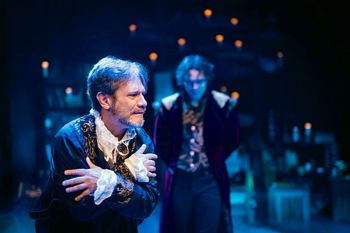
Doctor Faustus would seem to be a difficult play to stage, owing both to its dark subject matter and to Marlowe's episodic delivery of Faustus' descent. Open Window Theatre has taken on this challenge. The result is a stirring production, brilliantly performed by a cast of six who must all be exhausted after each performance, with direction by Jeremy Stanbary that hones in on the play's moral certitude while creating striking stage images. The totality is both artistically and intellectually rewarding. The character Faustus (or Faust) is a touchstone of western culture. He represents an individual's willingness to sacrifice long-term bliss for short term power, wealth, and/or glory. Marlowe's Doctor Faustus was first performed in 1594. Though Marlowe was English (a contemporary of Shakespeare), the play is set in Germany and based on a Historia Von d Johann Faustus, published in Germany in 1587. Johann Wolfgang von Goethe's later two-part play Faust, published in 1808 (Part 1) and 1832 (Part 2), is the better-known presentation of the Faust legend, having inspired numerous musical works (by Beethoven, Schumann, Liszt, Berlioz, Mahler and others), an opera by Charles Gounod, numerous films, and even a little-known musical by Randy Newman. Reaching back to the Marlowe play and its Elizabethan cadence endows the Faustian legend with a sense of the ancient origins of this timeless cautionary tale that warns of humanity's weakness for choosing short-term gratification at the expense of long-term reward and enlightenment. It is a dilemma still addressed today in churches and synagogues, in halls of academia, at community forums, and in political platforms and campaigns. The two main characters in Marlowe's play are Doctor Faustus and Mephistopheles. After an opening recitation by the play's chorus, who also close the final scene, we observe Faustus bored with is his safe academic life and seeking greater fulfillment through the dark arts. He invokes the aide of the devil, summoning Mephistopheles, an agent for Lucifer, Marlowe's stand in for Satan. Mephistopheles offers Faustus twenty-four years of increasing wealth, power, and amusement through mastery of magic and sorcery in exchange for spending the remaining years of his eternal life in Hell. Faustus agrees to this bargain, and the bulk of the play depicts his descent into ever-greater depravity, with Mephistopheles at his side to provide instruction and to cajole Faust away from any second thoughts that might cause him to renege on his agreement and seek mercy through repentance, offered intermittently by appearances of two angels, one good, one bad. Lucifer himself makes two appearances, one to dissuade Faustus from turning back with a very entertaining enactment (by the play's ensemble) of the seven deadly sins, and again, near the end, to claim Faustus' soul. There are comical interludes featuring a pair of clownish thieves who get hold of one of Faustus' books of instruction in the dark arts and apply these skills to their own betterment and amusement. Their success in doing so provides welcome comic relief, but also makes the point that, while Faustus feels himself gaining ever-higher status through his master of the dark arts, even fools and thieves can do as much, and that his growing sense of superiority is a deception that heralds his inevitable downfall. Shad Cooper gives an incredible performance as Faustus, conveying the man's initial sense of malaise, his arrogance and cavalier dismissal of the worth of anyone but himself, his short-lived elation with the application of his powers over hapless victims, and–in the end–his fraught recognition that, though terrified of what comes next, he has made this bargain and cannot retreat from it. Jonah Smith is remarkable as Mephistopheles, acting as Faustus' congenial instructor and partner in devilish merriment one moment, glowering at any lapse in Faustus' commitment to the enterprise the next. Smith manages to place Mephistopheles above the moral questions raised by Faustus' bargain–it is Faust who chose, and Mephistopheles is merely an instrument, there to facilitate the conduct of business. The other four cast members–Elizabeth Efteland, Josiah Fagerstrom, Olivia Olson, and Keith Prusak–each play a multitude of roles, shifting with wondrous virtuosity among bits as victims of Faustus' misdeeds, slithering demons emerging from the mist, dismayed academicians, prankish clowns, and a host of others, including Helen of Troy (regally portrayed by Efteland). Olson is especially notable as Faustus' squire who, in doing his master's bidding, sees the downward spiral Faustus has chosen, yet is powerless to alter it. All four actors are greatly aided by Bronson Talcott's inventive costume designs which allow for rapid changes that are able to invoke each of the characters without any loss of momentum in the play. That momentum is also the result of Stanbary's direction. which establishes a clear narrative path on which the play, in spite of the episodic construction Marlowe has given it, moves ever forward. Robin McIntyre's scenic design provides an abstracted space with a sense of late Middle Ages about it, well suited for the conduct of the play's action. Sue Berger's lighting design alters the stage environment as needed to create a sense of ethereal space, and Stanbary's sound design provides for both ambient sounds and the clear speech of the actors. I am not of fan, though, of having Lucifer's voice amplified to sound like a robot. How much more fearful a prospect it is if the epitome of all evil looks and sounds just like one of us. It is noteworthy that Faustus is a doctor of philosophy and science, not of medicine. He has achieved the highest level of learning in his academic circle, but is not a healer of any sort. When Faustus experiences boredom with his status at the pinnacle of intellectual achievement, he may have faced a choice: to seek greater fulfillment through service to increase the well-being of his fellow mortals, or to gain even more wealth and power by undermining the well-being of his fellow mortals thorough the dark arts of magic and sorcery. Marlowe, though, does not propose these choices in his play. Faustus is seen from the beginning gravitating to the latter. It would have been a more complicated story if it began with these two choices and the conditions that led to Faustus choose as he did. Instead, from the beginning, Faustus signs on for this one-way ticket that will pass through some spectacular uplands but lead inevitably to the lowest place imaginable. We do see several opportunities for Faustus to at least attempt to halt this trajectory, with the appearance of the Good Angel, and are left to wonder at his inability to do so. No use, though, drawing commentary about the play Marlow didn't write. The one he wrote, and that Open Window has boldly mounted, is a well-crafted and powerful drama. Open Window's superb staging rises to the occasion, providing its audience with stellar performances and prime production values. Moreover, it prods us to consider the tugs on human nature to make calamitous choices, and the manner in which we may avoid those foul choices and seek the betterment, not only of ourselves, but of all humanity and the world we share. Doctor Faustus runs through October 25, 2026, at Open Window Theatre, 5300 S Robert Trail, Inver Grove Heights MN. For tickets and information, please call 612-615-1515 or visit openwindowtheatre.org. Playwright: Christopher Marlowe; Director: Jeremy D. Stanbary; Set Design: Robin McIntyre; Costume Design: Bronson Talcott; Lighting Design: Sue Berger; Sound Design: Jeremy Stanbary, Props Design: Nate Farley; Technical Director: Justin Ranum; Stage Manager: Stephanie Mogren. Cast: Shad Cooper (Doctor Faustus), Elizabeth Efteland (Ensemble 2), Josiah Fagerstrom (Ensemble 4), Olivia Olson (Ensemble 1), Keith Prusak (Ensemble 3), Jonah Smith (Mephistopheles). |