|
Regional Reviews: Phoenix Angels in America: Perestroika Also see Gil's reviews of The Shark Is Broken, The Cher Show and Angels in America: Millennium Approaches
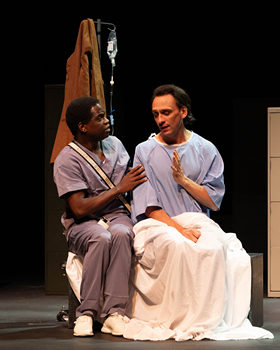
More ambitious and philosophical than the part one, Perestroika reaches for larger existential ideas, weaving together spirituality, suffering, and the search for meaning in ways that can at times feel dense or overly layered. While it's an expansive, rich evening of theatre, some of its interconnected themes and theories aren't fully cohesive, and the play places less emphasis on character progression than its predecessor. Still, despite occasional unevenness in the second installment of Kushner's work, Stray Cat Theatre's presentation of both parts of Angels in America is expertly cast and directed and seeing both parts in repertory results in a deeply rewarding and emotionally resonating theatrical event. Perestroika picks up almost immediately where Millennium Approaches leaves off, with the Angel crashing through Prior's ceiling to declare him a prophet and proclaim that "the Great Work begins." Suffering from AIDS and desperate for something more tangible than divine intervention, Prior resists the Angel's demands, especially after realizing she offers no salvation from his illness. Meanwhile, Roy Cohn, also dying from AIDS, spirals further as he faces impending disbarment and the awareness that the power he holds over others can't help his physical decline. Louis continues to wrestle with guilt after abandoning Prior, eventually beginning a relationship with Joe, the deeply closeted Mormon Republican struggling with his own identity. Joe's wife Harper remains emotionally adrift, retreating into vivid hallucinations and fantasies as her fragile grasp on reality continues to erode. Belize, Prior's loyal friend and nurse, ends up caring for the very man he despises in Roy Cohn, while Joe's mother Hannah unexpectedly becomes a source of comfort and support for Prior. As in Millenium Approaches, Kushner fills the play with characters who are flawed, selfish, frightened, and emotionally fractured, yet he writes them with enough honesty and humanity that they remain deeply compelling. Through unexpected acts of care and connection, these isolated individuals slowly become linked in ways they never anticipated. What ultimately emerges is an unconventional but moving sense of community. More than anything, the play emphasizes compassion and the surprising ways people can find connection across divisions of politics, identity, religion, and belief. Kushner continually challenges assumptions, revealing that the people we think we understand are often far more complex than they first appear. While there is a lot going on inPerestroika, and even though some of the themes aren't fully fleshed out, director Ron May's pacing ensures the scenes remain impactful and never feel rushed while also never once making the three and a half hour run time feel like a slog. Under May's insightful direction, the cast continues to display the depth and layers of their characters in superb portrayals. Marshall Glass is excellent as Prior. While his body language clearly shows us that Prior is sick, the conviction he instills in Prior is unstoppable and lets us truly see how Prior's role as a prophet has energized him and that Prior refuses to have any self-pity and never lets the illness get in the way of his determination to live life to the fullest. As Louis, Nathan Spector allows us to fully understand the guilt his character has in leaving Prior, and shows how the sadness he felt becomes a driving passion to make things right. As Roy Cohn, Louis Farber is a firecracker ready to explode at any moment, yet Farber's manic portrayal has many moments of lucidity that let us understand how Cohn's impending death brings a calmness to the character. Farber is also truly wonderful in the many outbursts Cohn has, including one humorous one that is truly hilarious. The clarity that Courtney Weir brings to Harper, now that she knows the truth of what's going on in her life, lets us see how Harper now has a firm and full grasp on reality. Weir is constantly engaging, present, and nuanced in her depiction of this layered woman. Devon Mahon allows us to truly see and feel the struggles that Joe faces and the understanding he has once his eyes are fully open. While I do think that Joe is the one character Kushner doesn't quite know what to do with, Mahon delivers a rich, fleshed-out and memorable portrayal. Michael Thompson is superb as Belize, instilling this fierce, funny, and compassionate character with dignity and strength, making every scene he's in feel alive with energy and conviction. Thompson's comic timing is superb. Nina Miller is equally as compassionate as Hannah, who finds herself unexpectedly helping Prior when he becomes ill. Miller's ability to also bring a true sense of honesty to Hannah is quite moving and she also does a wonderful job (as Ethel Rosenberg) with Spector, delivering the Kaddish for Cohn. As the Angel, Megan Holcomb is powerful, passionate, scary, and also quite humorous. While Perestroika is longer, looser, and has some moments that don't quite gel when compared to the first part, it still manages to end on a rich and rewarding note when Prior repeats the same message the Angel proclaimed at the end of Millenium Approaches, "the great work begins." That statement may mean less today than it did when the play first premiered over 30 years ago when the AIDS crisis was raging and people were dying from the disease daily, yet it still serves as a message of hope for and a call for action for us to stand up and join together with our families and friends against whatever comes our way. Both parts of Tony Kushner's Angels in America play in repertory through this weekend. Stray Cat Theatre's Angels in America runs through May 16, 2026, at the Tempe Center for the Arts, 700 W. Rio Salado Parkway, Tempe AZ. For tickets and information, please call 480-227-1766 or visit straycattheatre.org. Director: Ron May Cast: |