|
/
Regional Reviews: San Francisco/North Bay Julius Ceasar Also see Patrick's reviews of R.O.I. (Return on Investment) and Mamma Mia!
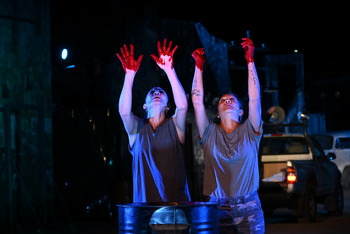
What you are about to read is my best attempt to convince you to find your way to the Forest Meadows Amphitheater in San Rafael for Marin Shakespeare Company's production of Julius Caesar, which is easily the finest production of one of the Bard's works I have seen ever in the Bay Area. Although the play is titled after the man who helped to bring about the end of the Roman republic and the birth of its empire, its story hinges more on the actions of Brutus (Bridgette Loriaux) and Cassius (Charisse Loriaux), the pair who plot to assassinate Caesar for his "ambition." The actors, who are sisters, bring an incredible sense of connection to each other, which plays perfectly into the text, as Shakespeare often has them refer to each other as "brother." (Brutus and Cassius were in fact brothers-in-law, and director Jon Tracy has changed the text so they call each other "sister.") Since I imagine virtually all of you are familiar with the basic plot–Caesar returns to Rome a conquering hero, is offered an emperor's crown, turns it down, is assassinated, precipitating a war in which most everyone dies, many by their own hand–I will concentrate on the brilliance of the production. If you've never been to Forest Meadows Amphitheater, it's a quiet spot at the north end of the campus of Dominican University. There's room for several hundred guests on the hard wooden bench seats (spring for the $5 cushion rental!), and the stage sits between two stands of trees. As you enter at the top level, there are warnings that the production will feature violence, gunshots, sounds of helicopters and jet planes (Tracy has set the play post World War II, prior to the digital age), and blood. Believe these trigger warnings. Especially about the blood, as we're talking 55-gallon drums of blood. Despite this sanguine excess and the loftiness of the language, nothing about this production is overdone. All that blood and all the violence is fully justified by Shakespeare's poetic tale of politics and power. Though the play runs two hours and 45 minutes (with one intermission), the action fairly flies along, so engrossed was I in the intrigue and political machinations of Caesar's Rome. Not to mention Shakespeare's gorgeous, imaginative, elegant language. As you take your seat, you will notice the wall upstage is covered with handbills that appear to have been there for some time–meaning before the war between Caesar and Pompey. The political handbills tout both men's pleas to the citizenry of Rome: "A Fighter for Rome: Caesar"; "Pompey: Defender of the Republic"; "Let Rome Rise Again: Caesar." (It's this last handbill that put me in mind of our current political situation: are we on the verge of losing our republic to a dictator's empire? That, and the line about how Romans might "claim the bully as hero" and Caesar speaking of himself in the third person–"Caesar shall go forth!," he cries on his way to the senate on the ides of March–made me think even more that this production can be read as a metaphor for present political maneuverings.) The set itself is arrayed with various seating options, a desk or two, an old-fashioned television camera, and two framed portals on casters that function as doorways, arches, and even at one point, an elevator. With the gender switch for Brutus and Cassius (as well as for Decius and Cinna), the role of Portia, Brutus's wife, has become Port, played with delicious juiciness by Steve Price. Tracy has changed more than the gender of Portia, he has reinvented the character entirely. Instead of a concerned stay at home wife, Port is now a general seemingly suffering from PTSD, wandering about the stage in his military coat with its medals, over nothing but a pair of dirty long johns, a bottle of liquor almost ever-present in his hand. The costuming choice here (costumes by Alia Davis Brown) portrays Port as a sort of commentary on hollow authority–the trappings of military command but nothing underneath. Port seems to be barely holding himself together, using the general's coat as a sort of protective armor. The two Loriaux sisters give utterly magnificent performances. Charisse embodies the "lean and hungry look," which disturbs Caesar with her sculpted face and fiery eyes. Bridgette is no less skilled playing Brutus as a woman with high-minded, selfless goals, seeking only the best for her republic and its citizens. As Mark Antony, Brady Morales-Woolery is the polar opposite of his role as Colonel Higgins in San Francisco Playhouse's production of My Fair Lady last year. Morales-Woolery lacks the movie star looks we've come to associate with Antony (perhaps initiated by the casting of Marlon Brando in the 1953 film of the play), but as Antony plays a peacemaker and a champion of the republic over an empire, his soft face and passionate voice won me over. He's an Antony who sneaks up on you and wins your friendship and loyalty through his own honesty and commitment to others. Johnny Moreno takes the title role of Caesar and milks it to perfection. His is a Caesar unlike any you have likely ever seen. The sense of inflated ego Caesar must have had after conquering Gaul and becoming Rome's de facto emperor seems to ooze from every pore. It's as though he imagines himself a rock god. His Caesar seems to be a music fan; early on, he spends several moments listening to Bread's 1970s hit "Make It With You," trying to figure out the chords on his guitar. He is often seen listening to songs on an early edition of the Walkman. His second act performance (he appears as a ghost) will both shock and delight you. Every aspect of this production is close to perfection. The sound design is utterly amazing. When I heard the sound of helicopters flying overheard I very nearly looked to the sky to see them pass. The gun shots are startling–but not as startling as the actors dropping to the stage as the bullets find their mark. The sounds of the roaring crowd come not only from speakers hidden in the trees, but also from members of the cast who place themselves within the audience. When the crowd shouted for Antony to read Caesar's will, more than a few of us joined in bellowing "Read it! Read it!" When I returned home and went up the street to pick up our dog who was staying at our neighbors, I asked–knowing they are seeing the show tonight, the day after I did–if they knew anything about the production. "No," they said. "Good," I replied. "Be surprised." I've tried to give you only a small taste of what Marin Shakespeare Company has in store for you, but I beg you, go be surprised–and delighted and thrilled and angered and amused and awestruck. Just go. Julius Caesar runs through September 13, 2026, at the Forest Meadows Amphitheatre, 890 Belle Avenue, San Rafael CA. The play is presented Thursdays-Saturdays at 7:30pm and Sundays at 5:00pm. There is no show on Thursday, August 20. Tickets are $16.99 (youth), $41.99 (seniors) and $52.49 general admission. There is a "pay what you will" night on Thursday, August 27. For tickets and information, please visit www.marinshakespeare.org. |