|
Regional Reviews: Seattle The Phantom of the Opera Also see Ed's review of Jesus Christ Superstar
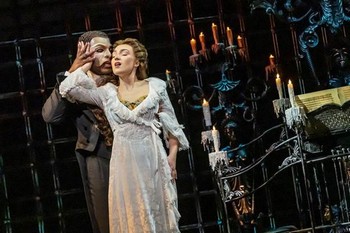
The story is based on the 1910 gothic romance novel by Gaston Leroux and tells the tale of a disfigured musical genius in love with the beautiful soprano ingenue named Christine Daaé. As Messrs. Firmin and André take over management of the Paris Opera Populaire, Carlotta, the resident prima donna, is almost killed as a set "accidentally" falls behind her. This and many other "accidents" have been attributed to the "Opera Ghost," a mysterious and menacing presence plaguing the opera house for years. Carlotta refuses to take the stage until the new managers "stop these things happening." Madame Giry, ballet matron, and her daughter, Meg, insist that Christine can sing in Carlotta's place and that she has had "a great teacher." Christine's performance is a triumph. After the performance, the new Opera Patron and childhood friend of Christine, Raoul, the Vicomte de Chagny, meets Christine in her dressing room, reigniting their friendship and affection. When invited to dinner with Raoul, Christine refuses, telling him that she has been visited by the Angel of Music, and mustn't leave. Raoul insists and leaves the dressing room to ready his horses. As he exits, Christine hears the voice of her "Angel," who appears behind her full-length mirror. The masked figure draws her through the mirror and takes her down beneath the Opera House and across an underground lake to his lair. She is spellbound by his presence, but faints in horror when she sees a mannequin of herself in a wedding dress. When Christine awakes disoriented, she finds the Phantom composing music at an organ. She sneaks behind him and strips off his mask. As she recoils in horror, the Phantom in his fury declares that, despite his grotesque face, Christine will learn to love him and that she will never be free of him. He then returns her to the Opera House, where he instructs the managers that Christine will play the lead in the next opera, and that Carlotta will play a silent role. Despite this, Carlotta plays the lead, infuriating the Phantom. The Phantom causes Carlotta to lose her voice on stage and drops the hanged body of stagehand Joseph Buquet from the flies. In the chaos, Christine and Raoul escape to the roof of the Opera House. Christine expresses her terror at the Phantom's obsession with her, and Raoul reassures her and expresses his love for her. As they head back to the stage, the Phantom emerges from behind a statue and declares war upon both the lovers. Back in the theater, the Phantom makes the chandelier shake, causing it to crash, triggering mass panic. Six months later at a New Year's masquerade ball in the grand lobby of the Opera House, the Phantom appears with a new opera he has written, Don Juan Triumphant. Carlotta is incensed that her part is so small and that Christine has secured the lead. The Phantom gives direction through mysterious notes throughout the rehearsals. Christine declares that she cannot sing the challenging role. Raoul convinces all assembled that if Christine sings, the Phantom will be certainly in attendance, enabling them to capture (or possibly kill) him inside the theater. Christine flees to the cemetery to seek guidance at the tomb of her deceased father. Atop the mausoleum, the Phantom appears to Christine, pretending to be the spirit of her musician father. Mesmerized, Christine begins to enter the mausoleum to join the Phantom. Raoul bursts forth, confronting the Phantom, who declares himself the Angel of Death. Raoul breaks the Phantom's spell and saves Christine. The Phantom declares war on both Raoul and Christine. Eventually, the Phantom forces Christine to choose between him and Raoul. Realizing she will never truly love him, the Phantom releases Christine and Raoul, ordering them to go and to never return. As the theater mob descends to his den, the Phantom quietly sits in his large chair and covers himself, hiding from the advancing crowd. As Meg enters, she approaches the chair and tentatively pulls back the cover, revealing only the phantom's mask in the otherwise empty chair. While it is unlikely that the original novel could be considered a literary masterpiece, the gothic and mysterious elements of the story are expertly translated onto the stage by Matt Kinley's lavish set designs, Andrew Bridge's lighting design and Mick Potter's expert sound design. The sets and scenic experiences never overpower the actors onstage or overshadow the story being told. Together, however, they create an immersive experience for the audience, deftly manipulating the perceptions and sense of place within the literal theater and within the story unfolding on stage. As impressive as the sets and scenic designs are, the actors uniformly bring the narrative to life, never letting the spectacle get in the way of the story being told. Every character brings full conviction and artistic dexterity to the stage. Special mention must be made here of Melo Ludwig in the role of Meg Giry. Ms. Ludwig infuses the smaller role with undeniable stage presence. Her extensive ballet training is on full display, and her voice is sweet and strong. It is her smile, however, that truly lights the stage when she appears. She is a future leading lady and prima ballerina whose career is exciting to anticipate. Jordan Lee Gilbert suffuses the ingenue role of Christine with a self-awareness that is often overlooked and interpreted as simple naivete. Ms. Gilbert imbues Christine with depth and complexity, creating a more fully human character than the ingenue role may suggest. She does so, too, with her truly amazing voice. She shows effortless range as she hits every high note in the first act anthem and title song "The Phantom of the Opera," and emotes low, smoldering desire in the second act seduction aria "The Point of No Return." Hers is a Christine that doesn't need saving exactly but is learning how to maneuver in a larger world than her upbringing suggested. Similarly, Isaiah Bailey's Phantom is a complex study of the product of abuse, neglect, and innate genius. He is undoubtedly the villain of the show, but his voice alone demands empathy and consideration despite his circumstances. Like Ms. Gilbert, Mr. Bailey's voice shows tremendous scope, not only in his vocal range, but in the depth of emotion with which he infuses it. He exhibits great gentleness, strength, and sincerity in Act One's "Music of the Night," as well as chilling calculated manipulation in Act Two's "Wandering Child." He, like Christine, maintains his humanity, never crossing the line to caricature. Daniel Lopez does an admirable job in the role of love-struck Raoul. His voice is smooth and rich, and pairs beautifully with Ms. Gilbert in Act One's love duet "All I Ask of You." The role of Raoul does not avail itself to much nuance or dramatic depth, but Mr. Lopez does not let his Raoul become boring. His is the weakest link in the dysfunctional love triangle, and he fortunately has the voice to keep the audience engaged, and Christine out of the Phantom's grasp. The Phantom of the Opera is not all gothic angst and foreboding. William Thomas Evans and Carrington Vilmont both show excellent comedic timing as the in-over-their-heads managers, Mssrs. Firmin and André, who try to convince themselves, and those around them, that all is well despite the chaos enveloping them. Likewise, the talented soprano Midori Marsh (Carlotta) and Metropolitan Opera veteran Christopher Bozeka (Piangi) display full opera diva absurdity while exhibiting their vocal gifts. Despite their onstage egos, they shine in the Act One's polyphonic ensemble "Prima Donna." No review of The Phantom of the Opera would be complete without its most famous feature: the chandelier. Where the original production found the chandelier onstage at the beginning of the show, here it is found shrouded in dust covers hanging low above the audience. Its illumination at the beginning of the overture, and its famous fall at the end of Act One are true feats of stage magic that presage the Phantom's command to "Let your mind start a journey through this strange new world/Leave all thoughts of the life you knew before." The chandelier is no longer the defining feature of the show, but an introduction to and reminder of the magic of live theatre and the community that forms when all are spellbound by the "Music of the Night." This is a production that will leave everyone spellbound and should be seen at all costs. The Phantom of the Opera runs through May 24, 2026, at the Paramount Theater, 911 Pine Street, Seattle, WA. For tickets and information, please visit STGPresents.org or visit the box office in person Monday - Friday, 10am to 6pm. Orders for groups of 10 or more may be placed by emailing Groups@BroadwayAtTheParamount.com or calling 206-701-8383. For information on the tour, visit www.thephantomoftheopera.com. |