|
Regional Reviews: Chicago Out Here Also see Christine's reviews of Fault and Windfall and Karen's review of The Angel Next Door
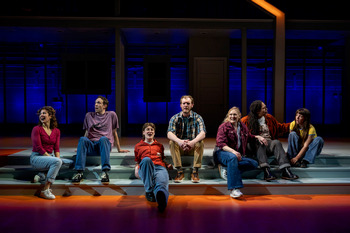
The story centers around Dawn, a lesbian who left behind a passionate, satisfying relationship with Robin thirty-some years ago for an "easier," heteronormative life as a wife and mother. Although there is no clear inciting incident, Dawn decides that her own life and the lives of her husband, Brian, and child, Cleo, need joy that cannot be found under their current circumstances. She tells Brian she wants a divorce, and the process unfolds against the backdrop of her own dysfunctional reunion with Robin, Brian's attempts to move on, and the complications of dissolving not just a marriage, but a family. From the play's early moments, the cast breaks the fourth wall, reacting with surprise to the presence of the audience, but rolling with it. They also become aware of the presence of the band, calling on them for underscoring, and even drawing one member, Martin (who turns out to be a licensed mediator who occasionally plays Dawn's best friend), out on to the stage to join the action. We first meet Robin and Gina, Brian's new girlfriend, as fellow members of the audience, and the convention of acknowledging the fact that what we are watching is a performance is good for some well-landed humorous moments, but the show's use of this asset sometimes muddles the narrative. Part of the show's meta conceit is acknowledging the gap between dramatic and real time. Robin, for example, first shows up late for the curtain and is seated in the front row. Dawn recognizes her and is surprised to learn that Robin already knows about her impending divorce. Robin, in turn, is perplexed because for her, the divorce has already been in progress for several months. This, too, is an interesting strategy, but one that is not always carefully deployed. For example, in the course of the conversation where Dawn first indicates that she wants to divorce, Brian suggests that they open their marriage so that Dawn can pursue relationships with women. It is not clear, given this acknowledged time slip, whether this indicates that Brian has long known that Dawn is a lesbian (or perhaps bisexual) and proposed this, or if the audience is meant to interpret this as a sort of desperate stab at preserving the family after a revelation about Dawn's sexuality that has blindsided him. More substantively, though, there are aspects of the play's setting that don't read realistically. The program simply states that events take place in the "here and now," but the opening song indicates that both Brian and Dawn now work from home, though they didn't in the past, so this seems to place the action firmly in the post-pandemic era. Robin and Dawn also make references to 1990 and 1993 (the beginning and end of their relationship), and Robin angrily reminds Dawn that her choice of "easier" means that she removed herself from the AIDS crisis, the fight for marriage equality, and other political struggles for the community in the course of their generation. Moreover, Robin's child, Jett, is twenty and Dawn's daughter, Cleo, is sixteen, placing these two in a very different cultural and political context than their parents. When Dawn, many months into the divorce process, finally comes out to Cleo (and then lies to her face when Cleo asks if Dawn is seeing anyone), the revelation is predictably a nothing burger to a junior in high school whose friends' families take many different forms. What is strange is that Cleo never introduces anything beyond a gaystraight binary into the conversation. She never wonders how her own existence figures into her mother's identity or her parents' marriage. Stranger still is the fact that Jett, a twenty-year-old nonbinary person and avowed communist, seems content to advocate for their mother with Dawn, a woman whose own internalized misogyny and homophobia continue not only to keep her volunteering for the closet (literally and figuratively within the context of the show) but also forcing their mother, Robin, into the neighbor's garden or Dawn's "green room" and so on. The end result is a show that centers on a white, cis lesbian who behaves rather terribly to everyone around her, despite their more or less uniform support for her and her choices. The drama and stakes end up feeling forced and artificial, and otherwise interesting characters suddenly become two-dimensional when Dawn's storyline demands it. But whatever flaws the work itself has, Court's production is very good on the whole. Co-scenic designers Andrew Boyce and Lauren M. Nichols create a doll's house of contradictions. The two-story structure of the house that Dawn, Brian, and Cleo share is suggested by a series of wide beams that light up with a variety of colors. On the main floor, the kitchen and living room are decked out with mid-mod furniture, and the slightly cluttered den that Brian uses as his office is rendered in darker tones, giving his corner of the house a distinct flavor. On the second level, Dawn's office is separated from the space the band occupies by a threshold that sits at right angles to the rest of the stage, and Cleo's cluttered bedroom sits opposite the band at stage left. Lee Fiskness has done a splendid job with the lighting design. The house's windows often pulse in technicolor counterpoint to the stark white and pale green of the house's outline and its upstage walls. During Cleo's rousing, rocking number, everything is bright rainbows, and Fiskness makes the meta-inclusion of the audience (and the actors planted within it) work seamlessly through the use of spots and subtle play between the house and stage lights. Christine Pascual's costumes are another strong element here. Dawn's suburban soccer mom look is an appropriately rigid, unchanging element until she dons a purple denim jacket near the play's end. In contrast, Cleo and Brian have baseline costumes, but added elements throughout indicate that the two are adapting to their shifting reality, or at least trying to. The costumes for Brian's girlfriend Gina and for Robin cast them both as archetypes, yet the two still feel like real, lived-in characters. The music is, unfortunately, one of the show's uneven elements. Certainly, the blend of obvious, memorable songs (e.g., Cleo's "Picture Perfect" and Brian's "Too Soon") with more fragmented pieces is familiar to any fan of musicals these days. Here, however, there are times when singers are left to carry melodies that aren't well-supported by the band and arrangements that don't seem to suit their voices. As Dawn, Becca Ayers is particularly affected by this. Her first solo number, "In the Closet," seems far too low for her comfort as a singer and the underlying music is sparse. Ayers does well in the duets and ensemble numbers, but what seems to be lack of confidence in solo singing means the more experimental numbers don't land as they ought to. This has a downstream effect on how effectively Ayers is able to render Dawn as a sympathetic character. On a related note, Bethany Thomas (Robin) is obviously an accomplished and powerful singer, but its seems equally obvious that the show and the production require her to hold back, vocally speaking. Moreover, the book gives this character short shrift; we know little about her life, other than the fact that she believes that her post-Dawn marriage was a somewhat passionless compromise (although it produced her child, Jett), and her sole reason for weathering the humiliations she suffers at Dawn's hands seems to be an unrealistic desire to return to the passion she experienced at a very different time in her life. Thomas does good work in adding subtleties to an underwritten character, but the perplexingly exclusive focus on Dawn's self-inflicted wounds leave much of this strong performance underutilized. Cliff Chamberlain is very good indeed as Brian, and it is worth noting that he and Becca Ayers do create interesting, productive tension together as they navigate the end of the life together that they've known. It's somewhat unfortunate, from the perspective of the play's intentions, that the burgeoning romance between Brian and Gina (Amanda Pulcini) may be the most interesting and well-rendered here. Chamberlain's hesitant song and Pulcini's disarmed and disarming responses from the audience are full of charm, and the ways in which Brian owns and immediately tries to remedy his own bad behavior in the messy confines of his dissolving marriage stand in stark contrast to Dawn's seeming lack of self-awareness and unwillingness to step up for the people she loves. As Cleo, Ellie Duffey has to deal with a character who is variously written as sixteen-going-on-thirty and sixteen and crying for her mother when she misplaces her math book. Duffey does very good work with this, elevating the role, rather than being bogged down by it. Duffy's work with Z Mowry, who plays Jett as centered, funny, and unflappable, furthermore suggests that the show would benefit from expanding the roles of the younger generation to enrich the conversations that the text is clearly interested in. In a similar vein, Alex Goodrich handles the intriguing, but imperfectly thought-out character of Martin the Mediator in such a way that one certainly wants a more consistently employed and better fleshed out character for the actor. Out Here runs through May 10, 2026, at Court Theatre, 5535 S. Ellis Ave, Chicago IL. For tickets, visit CourtTheatre.org or call the box office at 773-753-4472. |