|
Regional Reviews: Chicago Covenant Also see Seth's review of Going Bacharach: The Songs of an Icon, Christine's reviews of Scaramouche and Loki: The End of the World Tour and Kelly's review of The Wedding Singer
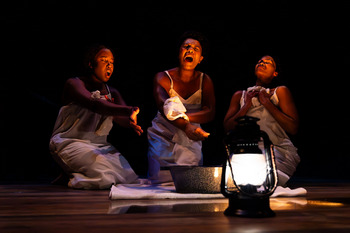
Walker sets the audience up to be sure this is a story they've heard before. Johnny "Honeycomb" James returns to town after two years, having lost his childhood stammer and mastered the guitar. He seeks out Avery, the only one in town who ever showed him kindness or encouragement before he left. Eager to escape her own rigidly devout mother and an equally rigid, unforgiving town, Avery takes Johnny at his word when he tells her that she's always been the only one for him and he not only wants her to join him on the road, but wants to marry her. Avery's mother predictably forbids her daughter from walking out with Johnny, let alone leaving town with him. The possibility of Avery's departure unmoors her younger sister Violet, not only because she receives little but criticism from their mother; Violet is also convinced that Johnny is both faithless and violent. Violet's best friend Ruthie, who finds some semblance of stability and care in the coldness of this home, is also desperate to prevent this turn of events, even going so far as to throw herself at Johnny outside the local juke joint. But Avery does leave. Moreover, she breaks her promise to return after two weeks. The women of her life unravel over the course of seven weeks before a letter arrives informing them that Avery and Johnny have married and the promised return has dissolved into a vague mention of visiting sometime, perhaps with a child in tow. When the two eventually do return, Avery is entirely changed. Johnny explains her staggering, almost non-verbal state as the result of being kicked in the head by a horse. Mama and Violet impose their own suspicions and understandings on to the crisis as the story proceeds through terror to its tragic climax. It's hard to overstate how craftily assembled Walker's narrative is. Each of the women relates a story to the audience that might be autobiography, legend, town gossip, or all three combined. Although each has its own dramatic arc, the audience only gradually comes to understand how they intersect and diverge from one another. And in calling the play "crafty," one risks implying that it is merely clever, perhaps inviting the audience to stay alert for the next twist and the next. Walker understands horror and suspense too well for that, though. It's impossible to look away from the deeply human interactions long enough to predict where the plot will go next. The Goodman provides the play with the excellent staging that this compelling, superbly paced story deserves. The scenic design by Ryan Emens creates a proscenium out of eerie black, bare branches. Downstage left is a single tree, hung with Spanish moss, and around the edges of the set are stands of rye grass. The primary set element is a wooden flat that suggests a building. But the slightly odd geometry, which echoes German Expressionist sets ever so slightly, hints to the audience that the play's interiors (confined to one scene in the church and then the house of Avery, Violet, and their mother) are not quite real spaces. The lighting by Gina Patterson and sound by Dee Etti-Williams slickly shunt the attention of the audience around the physical space and just as effectively destabilize the audience's sense of where, when, and in what metaphysical realm the story is at any given moment. Evelyn Danner's costumes are subtle and functional, adding to the story's subtext through color, cut, and layering. Every actor in the cast is excellent and as an ensemble, they seem to relish the opportunity to work with material of this calibre. As Johnny, Debo Balogun knows exactly how much to charm and dominate a scene through sheer force of personality. But just as surely, he knows when to pull back and let the stammering, uncertain boy shine through. The performance is strong and subtle enough that it's almost (but not quite) a disappointment to realize that the Robert Johnson allusions are a bait and switch and Johnny is not at all the main character–the play's women, collectively, are. The performance of Ruthie by Ashli René Funches is also important to destabilizing the audience's sense of who this story is about and who its heroes and villains (if such simplistic notions apply here) might be. It's Ruthie who initiates the story by match light, and Funches who frequently delivers the play's most expertly timed comedic beats. And yet, it is also Funches whose performance conjures up the most earnest, moving moments and whose longing ultimately lands the play's climax. As Avery, Jaeda LaVonne both works and subverts the trope of the tortured, dutiful elder daughter and town Madonna. She exudes an open lovingness that renders Johnny's steadfast attraction believable, even as it productively complicates her place as the favorite within her own household. As the undone specter that hangs over her household later in the play, LaVonne is physically imposing and hair raising as the plot demands. As Violet, Felicia Oduh is the play's straight woman, yet this role does not reduce her performance. Oduh's impatience with Ruthie, love for Avery, hatred of Johnny, and ambivalence toward her mother all blend into a believable, lived experience. Although the reasons for Violet's mother's coldness toward her younger daughter only emerge later in the play, Oduh conveys that the dynamic between mother and daughter is longstanding. Similarly, although the character's animosity toward Johnny deliberately reads as overblown early on, Oduh takes care to sow the seeds that make this believable and sympathetic in retrospect. Finally, Anji White is more than up to the particularly challenging task of rending Avery and Violet's mother a sympathetic character. Just as Walker lures the audience into believing that this is a story about a man selling his soul to the devil for guitar prowess and all its downstream benefits, the character of Mama, at fist, seems to be a simple plot device: She motivates Avery's departure, and her coldness drives Violet to, at first, try desperately to step into the role of daughter. White does not shy away from the unlikeable nature of the character nor the unsavory, hypocritical realities that emerge as the play proceeds. White plays the character as one who was, once upon a time, sustained by her faith, but who now feels that this faith, to some extent, appropriately punishes her for her sins. And yet, for all her broken coldness, White garners at least a modicum of sympathy from the audience. Covenant has been extended through June 7, 2026, at Goodman Theatre, Owen Theater, 170 N Dearborn, Chicago IL. For tickets and information, please visit GoodmanTheatre.org or call 312-443-3800. |