|
Regional Reviews: Chicago The Birth of the Pill Also see Christine's reviews of The Swallow and Shane, Karen's reviews of I Killed Andy Breitbart and The Man Who Fell with the Rain, and Joe's review of Come from Away
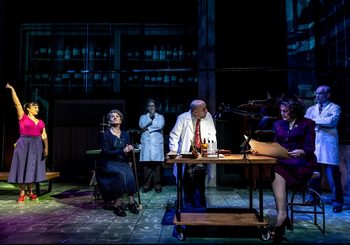
Jessica Huang's adaptation of Jonathan Eig's book provides the backstory of the Pill's origins and is never anything less than fascinating. The play, directed by Sandra Marquez, is said to be "in conversation with the book," and that is a perfect way to see it. Yes, it relates the story faithfully without pulling any punches, but it also deals with the one punch that Eig pulled: the Pill's very problematic human testing in Puerto Rico and the health problems that stemmed from that high-dosage first version of the medication. That issue is dealt with from the outset. Maria Victoria Martínez plays Ramona Delgado, a delightful character she calls "the star of the show," who is our guide through the story. Ramona, a totally fictional character, is indeed the star, possessing the power to freeze the play so the audience can better understand things. As we will come to understand, she also represents all of the Puerto Rican women whose lives were disrupted or ruined by the nonconsensual test of the drug. But more on that later. Martínez is first seen as Ramona sits on a bench reading from Eig's book, musing about its massive impact on the world. Ramona is an entirely sympathetic character, which distinguishes her from most of the others we meet, the first of which is the iconic Margaret Sanger (Janet Ulrich Brooks), founder of Planned Parenthood, from whose vision the idea of the Pill manifested. We meet Sanger as a septuagenarian who has just had a heart attack and has realized that her lifelong dream of an oral contraceptive that could level the playing field between men and women is in danger: for one thing, she might not live long enough to marshall it into existence; for another, she doesn't have enough money to pay for scientists; and finally, there is the trivial fact that, in 1950, contraception is against the law. Sanger's reaction is to fight past all of the impediments; Brooks shows her character's deep resolve and focus: This is a legacy-making mission for her and she knows it. But it is this determination that causes–or at least does nothing to help–dark parts of the story. Martínez plays other characters throughout the play, and arguably the most important one appears in a brief scene in which she plays a thirty-year-old Puerto Rican woman who "can't" have another baby–it would be way too much for her. She's sick and frightened and postpartum and in pain, but her nurse (a caricature played by Sanger/Brooks) is inattentive and unsympathetic. This could be a flash to the past or a flash to the future; it doesn't matter. The moment shows the sad reality that these women are seen as expendable. The play (like the book) does not shy away from Sanger's support of the pseudoscience of eugenics; she had seen too much suffering, she tells us, and wanted to alleviate it by sterilizing women from the underclasses, bringing the population down by stopping "undesirable" babies from being born. That this philosophy is reprehensible never seems to matter, and history is not certain whether the vile things she said were a sincere belief or a means to an end. It doesn't matter, really: she was a woman defined by her driven nature, and Brooks shows that drive throughout the play. One of the first things she does is steal Ramona's power, becoming the one in control so that she can guide her dream to reality. Mitchell J. Fain plays the hormone specialist who will ultimately create the Pill. When she first meets him, he requires a lot of convincing. (The above-mentioned deterrents scare him.) But his Dr. Pincus proves just as driven as Sanger once he gets going, and he is able to do that due to the generosity of a friend of Sanger, a very wealthy widow named Katharine McCormick (Mary Beth Fisher). McCormick has more money than she knows what to do with–we're told that she is the richest woman in America–and the opportunity to donate a couple of million dollars (close to $30 million in today's currency) to such an important cause is just what she needs. Fisher's McCormick may be a close friend of Sanger, but she's a much more empathetic character; the actress even allows her to smile at times. Assisting Dr. Pincus is a younger doctor named Min Chueh Chang (Rammel Chan), who works in the lab with the dozens of rabbits and rats that will meet their ends in pursuit of the Pill. Chan and Martínez (playing a remarkably knowledgeable secretary) have an easy chemistry, and their scenes together are among the lightest and most enjoyable in the play. Also involved is Dr. John Rock (David Parkes), a respected, if self-important, obstetrician whose Catholic faith proves too little to stop his work on the Pill. (One wonders whether Pope Paul VI's 1968 encyclical against birth control would have swayed him. Probably not, if this portrayal of the doctor is accurate.) Marquez and her cast perform on a cleverly designed stage by Regina Garcia that makes excellent use of simple dividers and leaves plenty of height for Mike Tutaj's projections. The proscenium set-up shows off the flexibility of TimeLine's new space, which was configured into a three-quarter thrust for The Enemy of the People, their first play in their new home. All of the tech, as expected, is excellent. Conchita Avitia's lighting both helps separate the space and also helps Ramona and Sanger freeze the play, while Matthew Chapman's sound design aids location among other things, and outfitting the lab must have been fun for properties director Saskia Bakker. Margaret Sanger was a controversial figure, but Huang and Eig show her warts and all as the person most responsible for midwifing the Pill into the world. Watching this play reveals the moral codes that were skirted or ignored, which were myriad, and the price unsuspecting Puerto Rican women paid for the freedom of every woman on Earth. Ramona asks Sanger near the end if, knowing everything she now knows, she would do it the same way again. Sanger says yes, but we are left with misgivings because in 2026 we know that the ends don't always justify the means. Nonetheless, as right-wing politicians strive to take rights away and birth control is on their agenda, we know exactly what the world would be without it. We've seen it all before. The Birth of the Pill runs through October 4, 2026, at the TimeLine Theatre, 5035 N. Broadway, Chicago IL. For tickets and information, please visit TimeLinetheatre.com. |