|
Regional Reviews: Chicago The Swallow Also see Karen's reviews of The Birth of the Pill, I Killed Andy Breitbart and The Man Who Fell with the Rain, Christine's review of Shane, and Joe's review of Come from Away
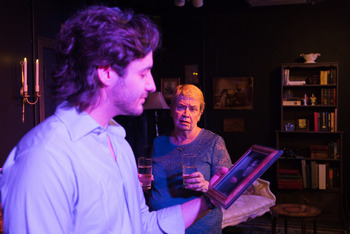
The story opens with a Emily, a demanding voice teacher attempting to brush off the young man, Ray, who has come to her for lessons. When Ray's promises to work hard fall flat, he shares that his determination is born of a promise to sing at the memorial for his mother, who was killed in an accident a year earlier. Emily relents, but as the two begin their work, it becomes clear that there is more to Ray's presence in her home than he has let on. Ray guides the conversation toward Emily's son, Danny, who turns out also to have died roughly a year ago. Moreover, it emerges that Ray and Danny had been at the same school and even in the same choir as teenagers. Although Ray initially claims to have barely known Danny, he is able to draw Emily deep into sharing her memories as he doles out incidents from their teenage years. Despite her initial claim that Danny died in an accident, she eventually reveals that he was one of dozens killed by a mass shooter in a gay nightclub. Ultimately, this builds to Ray admitting that he not only survived the same attack, but that Danny, with whom he'd been a long-term relationship, had saved his life. There are things that OSA's production is poised to do well and that it capitalizes on. The intimate space of the 25-seat theater is an effective setting for a conversation whose intensity and pain build over the course of the show's 90-minute runtime. Rick Paul's scenic design tells us a great deal about the music teacher with a few carefully arranged book shelves, the piano that dominates the space, an uncomfortable-looking faux provincial love seat, and a motorcycle helmet and leather jacket still hanging on the coat tree by the door. Dominique Favre's out-of-closet costumes also effectively serve as visual shorthand. The teacher's capris, lace overlay top, and ballet flats speak volumes about how she sees herself and wants others to see her. Similarly, Ray's casual yet put-together look is an extension of the charisma that keeps his foot in the door, even as the teacher's suspicions mount and she looks to escape from the confrontation. But there are other aspects of the production that don't work as well. Notably, Sean Smyth's lighting design introduces lighting cues that seem too dramatic for the feel of the rest of the show. In Smyth's sound design, the insertion of music and birdsong occurs too sporadically to be well integrated. There is something more fundamental here that does not quite work, or at least not as consistently as it needs to. It's not clear whether this is down to flaws in the original play, the difficulty of translation, unsteady direction, or some combination of the three. Whatever the origin of the difficulties, the show sometimes skips awkwardly between long monologues and what seems intended to be more naturalistic dialogue. Until the final moments, which are certainly effective, the actors seem far more comfortable with their long speeches than with the interactions between characters. This is pronounced to the point that there are times when it seems as if dialogue is merely a means of travel from speech to speech. It's to the credit of Michelle McKenzie-Voigt (Emily) and Jim Nally (Ray) that they do offer performances that mutually complicate one another. Whatever shortcomings there may be in the original play, the translation, or the direction, the actors' interpretations of their characters convey that both are flawed while definitely and simultaneously resisting any kind of "very fine people on both sides" interpretation of those flaws. Moreover, the two successfully tap into complexities that do seem present in the play. Although both characters draw on tropes like generational differences and social identities, neither actor gives into the idea that the conflicts between the two characters are so easily reduced. The Swallow runs through October 18, 2026, at Open Space Arts, 1411 W. Wilson, Chicago IL. For tickets and information, please visit openspacearts.org. |