|
Regional Reviews: Minneapolis/St. Paul Red Also see Arty's reviews of Macbeth, Whoosh! and My Name Is Florence and Deanne's review of Go, Dog. Go! Ve Perro ¡Ve!
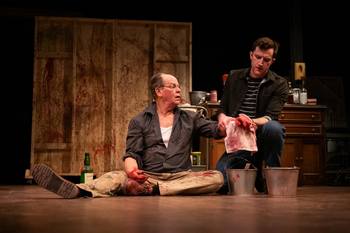
Ken (Ben Shaw) shows up at Rothko's lower Manhattan studio for his first day of work–or perhaps, he thinks, for an interview–dressed in a well-tailored blue suit and necktie. As he enters, Rothko (Pearce Bunting) stands with his back to the door through which Ken just passed; the artist doesn't turn, but senses his new assistant is there and puts up a hand imperiously, commanding Ken to halt. Rothko (in splattered painter pants and a silky shirt, also splattered, half unbuttoned over a white undershirt) continues to look outward, examining the work he has just completed. Actually, though, the work is not on stage, so the artist is looking appraisingly at the audience. Eventually, Rothko waves his hand to beckon Ken forward, still not looking at the young man. When Ken steps sufficiently toward the painting, Rothko utters the first line in the play: "What do you see?" No response will satisfy Rothko. He is the artist as a man wondrously creative, slightly deranged, deeply arrogant, and profoundly insecure. He cannot talk about any other artist, even those he grudgingly admires, without dwelling on their flaws–personal, creative or both–thus boosting his own stature in the pantheon of creative genius. He takes delight in the fact that he and his peers, such as Jackson Pollock and Frank Stella, stomped on the work of their predecessors at the apex of the art world (e.g., Picasso, Matisse), but he is livid that a new wave of artists (e.g., Warhol, Rauschenberg) is itching to do the same thing to his work. He asks Ken wildly open-ended questions, and badgers him into narrowing down the response to what he wants to hear. But, over the course of the play's 90 minutes, which straddles two years of the men's lives, Ken, an aspiring artist, develops his own voice and ability to challenge his "master." He took the job, in part, in hopes of learning from a renowned artist, perhaps even having his employer advise him and promote his work. As Ken realizes that Rothko is pathologically self-absorbed, he has less and less to lose by pushing back, setting boundaries, and calling Rothko out. In particular, Ken calls out the hypocrisy of Rothko accepting a fabulous commission to create "great art" that will adorn a restaurant where titans of business and industry who Rothko scorns forge deals over power lunches and, if they notice the murals at all, will consider them as mere decorations. The back-and-forth debates about the role of art, the nature of inspiration, the proper way to discern the substance of a painting, and more along that vein, may sound like dry going, but Logan's razor-edged writing makes Red consistently riveting. It helps tremendously that his creation of Mark Rothko as a bully with raging insecurity, desperate for his life's work to "matter," is a wonderfully complex, albeit not very likeable, character, and that Ken is presented as a person who enters that charged arena as a blank slate, and that we see him develop his own ideas along with the courage to state them aloud. Ellen Fenster-Gharib's direction takes that first strained encounter between the two men as a launch pad, layering on strata of tension, just as Rothko built layers upon layers of paint to create texture and give an inner life to the solid color blocks that are his calling card. Each scene builds upon the last, the energy becoming increasingly taut, as we anticipate an implosion of some kind. When it comes, it feels like an authentic climax to everything that precedes it. Pearce Bunting is one of the Twin Cities foremost utility actors, able to convincingly blend into character without drawing attention to himself. Rothko, though, is a character who demands attention. For this outing, Bunting creates a thoroughly absorbing portrait of the man, conveying his keen intellect, passionate creative instincts, and obsessive need for validation. Ben Shaw's performance as Ken starts off so mildly that one supposes he will be mercilessly dominated by Rothko. Gradually, with great persuasiveness, Shaw's Ken evolves into Rothko's equal, able to stand on his own and return intellectual firepower. It is a marvelous case of an actor making a character's change over the course of 90 minutes feel not only real, but inevitable. The excellent costumes were designed by Sarah Bauer. Carl Schoenborn designed the set, effectively using just a few elements, including stretched canvases leaning upright to mark the boundaries of Rothko's studio. Schoenborn also designed the lighting, which is essential in creating different ways of looking at colors, one of the key tenets of Rothko's work. Aaron Newman's sound design includes a steady background of classical music, which Rothko plays on his circa 1950s portable phonograph, as if the musical legacy of the great masters will enshroud his own work in a legacy of timeless endurance. Unlike other productions of Red, the set does not feature likenesses of the actual murals Rothko created for his commission, leaving this to our imagination. While this reduces our understanding of the specific vision Rothko was aiming for, by removing that specificity from the discussion of art it frees the focus from one artist's style versus another's, or the intention of one group of artists versus another's (the cubists versus the abstract expressionists, say) to more global questions about the nature of art. The driving question may then shift from "which art?" to "why art?" I personally did not miss those likenesses, for Bunting and Shaw on stage gave me more than enough to look at throughout the play. There is a scene in which the two paint together on a single canvas, starting with broad, easy strokes, then picking up speed and whipping up to a near frenzy, a wonderful illustration of the creative impulse overwhelming the artist's rationality. There is a line that especially puts a perfect spin on an artist's relationship to his work, when Rothko states that his greatest fear is letting a new work, one that he has protected in his studio, out into a world replete with criticism, likening it to sending into "a room full of razor blades, knowing that it will be hurt." Red has a solid pedigree. It opened in London in 2009 before being transferred to New York with the director, Michael Grandage, and two-person cast, Alfred Molina and Eddie Redmayne, intact. In 2010, Red was awarded six Tony Awards, including Best Play, Best Director, and Best Performance by a Featured Actor for Redmayne. It has since been performed far and wide, including several productions by companies in the Twin Cities. Gremlin Theatre's current production does this solid play full justice. It mines the text for its intellectual heft and emotional fervor, with direction and performances that would be hard to top on any stage. Especially for anyone interested in the purpose of the arts in society and the progression with which the arts both promote and reflect change in society, Art should not be missed. Red runs through March 1, 2026, at Gremlin Theatre, 550 Vandalia Street, Saint Paul MN. For tickets and information, please visit www.gremlintheatre.org. Playwright: John Logan; Director: Ellen Fenster-Gharib; Scenic and Light Designer: Carl Schoenborn; Costume and Prop Design: Sarah Bauer; Sound Design: Aaron Newman; Painting Consultant: Lolly Haas; Technical Director: Carl Schoenborn; Assistant Director: Libby Gens; Stage Manager: Sarah Bauer; Assistant Stage Manager: Stayci Bell; Producing Artistic Director: Peter Christian Hansen. Cast: Pearce Bunting (Rothko), Ben Shaw (Ken). |