|
Regional Reviews: Minneapolis/St. Paul The Glass Menagerie
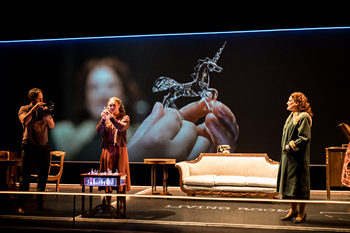
In Theater Latté Da's mesmerizing production of The Glass Menagerie, director Justin Lucero dives deeply into that notion, that our memories are fractions of a whole. Like a film, they may zoom in on particular details at the expense of others or zoom out for a wide angle shot that blurs the specifics. Lucero accomplishes this by taking that fact that Tom is a frustrated, aspiring writer (commonly considered a stand-in for the playwright himself) and has take notes on both the details and broad sweeps of his domestic life that, a decade later, becomes the basis for this account (that became Williams' first success). Rather than jotting those notes on paper, he records them using a camera, privileging the audience to see close-ups on the wide screen behind the fragments of rooms in Joe Thomas Johnson's set design. These images sometimes linger, for what feels like an uncomfortably long time, on teeth and lips that form a smile, or catch the light rising from below that makes a glass unicorn truly appear to be enchanted. On stage, we see what Tom can see; on the screen, we see what he will remember. When I read about this novel concept for staging the play, I feared it would amount to no more than a gimmick, but I am fully disabused of that notion now that I have seen the results. It works brilliantly, with Adam J. Thompson credited for design of the extraordinary video and projections. Similarly, the production incorporates a soundscape using live instruments, sound effects, and recorded music: superb sound design and original music composed by Katherine Horowitz and delivered by Brandon Brooks as soundscape artist, nested in a booth wedged into one side of the theater between the stage and audience. Marcus Dilliard's lighting design focuses, like the camera, on whatever is essential at the given moment, be it the full sweep of the stage, the fire escape to which Tom flees from his family for smokes and solitude, or the luminescence rising beneath the small cart that contains Tom's sister Laura's precious collection of animal figurines, the glass menagerie of the title. The play is set in St. Louis, where Williams lived from the age of eight until leaving home in his early 20s. Tom Wingfield (Williams' given name was Thomas) yearns for poetry and meaning in life. He is profoundly frustrated by the banality of his job in a shoe warehouse (Williams also held such a job for a period). Worse is his mother Amanda's constant harping about what she considers his numerous unhealthy habits. These include everything from his posture to smoking to staying out all night at the movies (or so he says). He is also oppressed by her frequent scolding his lack of ambition–the desire to be a writer not considered a serious ambition–and that his salary is inadequate to support her and his disabled older sister, Laura. Laura's physical handicap affects her gait and makes movement slow and awkward, but her greater disability is her crippling shyness and lack of confidence. She retreats into obsessively admiring and polishing her collection of the miniature glass animals and listening to old records on a wind-up Victrola. Amanda fears for Laura's future, having no means of support unless she marries, an increasingly unlikely prospect. To this end, Amanda prevails on Tom to invite some suitable nice young man from work to their home to meet Laura. Amanda constantly relives her own brilliant maidenhood in Mississippi, beleaguered by gentlemen callers, many of whom, as she recalls, were far better prospects than her children's father, who won her over with charm, turned out to have little else to offer, and has long since abandoned them. Dustin Bronson is wonderful as Tom Wingfield, presenting himself in the opening of each act as the older Tom drawing out his memories. Here he is somewhat more effete in speech, manner, and appearance (with a colorful scarf jauntily encircling his neck), as Williams, and perhaps Tom, had forsaken heterosexuality and taken to having love affairs with men by time in his life. Those qualities are less apparent when we are viewing his memories as a young man living in his emotionally stifling family home. Bronson is equally persuasive as dreamy-eyed Tom on the fire escape, looking out into his unknown future, a combustible brute lashing out at his domineering mother, and a tender-hearted brother who loves his sister, but is unable to sacrifice himself for her wellbeing. It is a brilliant performance, the best I have ever seen by this accomplished actor. Norah Long is mesmerizing as Amanda, wrapped in the double-edged memories of her life as a Southern belle, which allows her to claim a parcel of quality in her life to hang onto in the face of the heap of disappointments she faces in the present. One suspects that her memories are more fantasy than fact, but Long convinces us that Amanda "remembers" them with certitude, recapturing–or perhaps inventing–the rapture of those long-gone days. She also conveys Amanda's desperation to resolve the predicament of her life, and to quickly hatch a scheme or cover-up a fiasco, unable ever to admit defeat. Amy Eckberg is touching as Laura, unfolding like the petals of a tulip when she is at last able to feel at ease in the presence of a man. Brandon Brooks–who greatly impressed me back in 2014 as Young Max (the expressive dog) in Children's Theatre Company's How the Grinch Stole Christmas–fulfills that promise with a marvelous rendering of Jim, the unwitting gentleman caller, exuding self-confidence and empathy, whose intention to deliver nothing but good will fails to salvage the disaster that awaits the Wingfield home. Prior to his entrance as Jim, Brooks ably serves as the production's soundscape artist. Brooks and Eckberg create a moving sequence when Jim persuades Laura to set aside her fears and dance with him, transforming her into a person with untapped grace and him into a person capable of seeing below the surface into the well of another person's being. Assistant director Connor Berkompas is credited with the lovely choreography. Amber Brown's costume designs effectively capture the essence of each character. Amanda's reconstruction-era dress, pulled out to entertain the gentleman caller, is hopelessly dated and overly fussy, without (as is the case in some productions) seeming ludicrous. It is not a joke, but a dress that was very much in style once, one that would mark the woman wearing it as a person of substance and taste. The garment drives home the notion that Amanda's problem is not selecting the wrong dress, but being trapped in the wrong time. Every time I see The Glass Menagerie I am deeply moved by Williams' blend of tenderness and fierce longing, and his warning that to study our past can bring delight, but can also invite the pain we have tried to outrun back into our lives. Lucero's production maintains all that, and adds an additional element by suggesting that the way we assemble memories has less to do with flipping through old photos, and more to do with arranging the torn remnants of old photos and filling in the gaps as best we can. This is a thoughtful and beautifully conceived production of a brilliant play. The Glass Menagerie runs through March 8, 2026, at Theater Latté Da, Ritz Theater, 345 13th Avenue NE, Minneapolis MN. For tickets and information, please call 612-339-3303 or visit theaterlatteda.com. Playwright: Tennessee Williams; Director: Justin Lucero; Music Director: Denise Prosek; Scenic Design: Joe Thomas Johnson; Video and Projections Design: Adam J. Thompson Costume Design: Amber Brown; Lighting Design: Marcus Dilliard; Sound Design and Original Music: Katherine Horowitz; Wigs, Hair and Makeup Design: Emma Gustafson; Props Design: Madelaine Foster; Assistant Director & Choreographer: Connor Berkompas; Dialect Coach: Gillian C. Rosewell; Video & Projections Associate: Dat Peter Tôn; Technical Director: Bethany Reinfeld; Stage Manager: Shelby Reddig; Assistant Stage Manager: Samantha Smith; Director of Production: Kyia Britts. Cast: Dustin Bronson (Tom), Brandon Brooks (Jim/Soundscape Artist), Amy Eckberg (Laura), Norah Long (Amanda). |