|
Regional Reviews: Minneapolis/St. Paul Men on Boats Also see Arty's reviews of The Glass Menagerie and Red
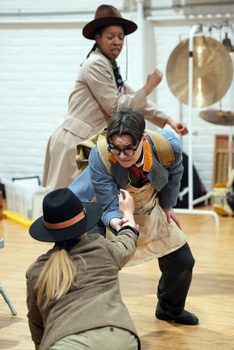
What makes the theatre company and play such a good match? The published play suggests minimal or no scenery. No company operates more minimally and leaves more to the imagination than Ten Thousand Things, known for using the barest of scenic elements that can fit in a van–along with props, costumes, and musical gear–to perform, with all the lights on, at unlikely venues and reach audiences that rarely have the opportunity to experience live theatre. In this case, the entirety of the set pieces, designed by Sarah Brandner, are a few crafted rocks a couple of feet high, large and sturdy enough for an actor to stand upon, positioned around the playing area as needed. Another way in which this production is well matched to the play is director Joy Dolo's extensive experience as an improv artist and movement coach Isabel Nelson's experience in devised theatre, notably in her work with Transatlantic Love Affair. The actors in Men on Boats enact scenes with chaotic, seemingly random movements of river travelers flailing in cold river water after a boat capsizes, and the synchronized movements of men rowing through turbulent rivers, all exquisitely choreographed to create a sense of the real thing. The physicality of the production is beautifully realized, creating vivid stage imagery out of nothing but the actors' movements. Those elements and a collectively strong cast make Ten Thousand Things' Men on Boats a wonderful theatregoing experience. The play tells an exhilarating story that both lionizes and challenges America's mythology of conquering the frontier, while using inventive stagecraft of the first order. The latter includes period-appropriate music and effective sound effects devised and performed by Walken Schweigert, as well as Sarah Bahr's well-conceived costumes. Powell's 1869 expedition was undertaken by a band of ten CIS white men. Backhaus' stipulates that "the cast should be made up entirely of people who are not (CIS white men). I'm talking about racially diverse actors who are female identifying, trans-identifying, gender fluid and/or gender non-conforming." Ten Thousand Things' production fully adheres to this requirement. I have seen Men on Boats once before and in that prior production I had the feeling that putting actors of diverse gender and racial identities in roles one would expect to be taken up by white men enhanced the characters' humanity and removed the burden of trying to convey bravado and manliness. In Ten Thousand Things' production, under Dolo's direction, the effect is much the same, and even more so, as the actors seemed free to create characters without submitting to archetypes. The play uses the historic names and vocations of the ten men, as well as the names given to the four boats on which they set out. Their leader, John Wesley Powell, is sailing on the Emma Dean, which he named for his wife. Powell lost an arm in the Battle of Shiloh but had enough mettle to still be a commanding presence, and to be appointed by the President Garfield himself to lead the expedition. George Keller is wonderful in the role, conveying and fighting to maintain the authority it requires, while expressing rapturous appreciation for the grandeur of the landscape. There is a pride in being the first white men to view it, and the privilege that affords them to name particular features–mountains, bluffs, and such–though with a realization that the native people have been there and no doubt given these same features names of their own. Also setting out on the Emma Dean is a former union soldier, John Colton Sumner, played by Maureen Sherman-Mendez to convey Sumner's confidence and cool head. The third man on the boat is hunter and trapper William Dunn, a role usually played by Adelin Phelps but covered by understudy Michelle de Joya at the performance I attended. De Joya's performance was flawless, as she presented Dunn as an independent thinker who, when the going gets rough, challenges Powell's decisions. Travelling aboard the Kitty Clyde's Sister is Powell's older brother, who goes by the monicker Old Shady, a reliable hand devoted to his brother, but carrying scars from his Civil War experience that fosters a surly demeanor, with few words for his fellow travelers. The role is played with perfect pitch by Karen Wiese-Thompson. She puts gusto into a couple of songs Old Shady sings that comment on the state of the expedition. Sailing along with Old Shady is the youngest of the men, Bradley, eager to prove himself among this more seasoned company, and played with animated energy by Anya Naylor. A boat called the No Name carries O.G. Howland, a printer and hunter, and his younger brother Seneca, played respectively by Emjoy Gavino and Charli Fool Bear, who convey the fraternal ties between the two. With them is Frank Goodman, a British gent of means with no particular role on the journey–one wonders if he hadn't helped to finance it–who, performed with brio by Elise Langer, effuses enthusiasm for this grand adventure, but finds the rigors to be more than he had bargained for. The last of the four boats, the Maid of the Canyon, carries Andrew Hall, a mapmaker charged to chart the territory they traverse, whose ability to consider things from a higher perspective comes across in Ashawnti Sakina Ford's performance, and R.W. Hawkins, another Civil War veteran and the expedition's resilient cook, played by Jay Owen Eisenberg in a marvelous performance as Hawkins repeatedly adapts to losses of food stores to mold and river rapids, while maintaining a can-do attitude. Overall, the writing is crisp and the dialogue feels authentic. Backhaus includes scenes, staged with a sense of danger, in which the men must work together to rescue fallen comrades that convey their absolute dependency on one another. However, she also drops occasional anachronisms into the play, such as the crew of one of the boats declaring theirs to be the "party boat," and the sarcastic tone of a pair of Ute natives (played by Emjoy Gavino Charli Foot Bear) whom the explorers encounter. Since the play isn't, overall, devised as a parody, these moments feel somewhat out of place, but they pass easily enough without marring the overall sense of the play as a reconstructed historical pageant. The performance I attended was in the gymnasium of Camden High School in Minneapolis, with about a dozen outsiders like me and about eighty Camden students in the audience. Like me, the students were fully engrossed throughout the play's two acts. Among those students I saw just four who appeared to be white, with the remainder being students of many colors. That is hardly the demographic we typically see at stage productions in any of our traditional theater spaces. At intermission and after the play, I overheard students discussing which were their favorite characters, the cool use of imagination instead of actual scenery to create the setting and portray action, and generally responding with approval. Those kinds of responses are certainly evidence of the value Ten Thousand Things brings to our communities. For its striking stagecraft, sturdy performances, and a slice of little-known American history viewed from a fresh perspective, Men on Boats is another bulls-eye by Ten Thousand Things. Men on Boats, a Ten Thousand Things Theater Company production, runs February 19 - February 22 at the Open Book, 1011 Washington Ave. S., Minneapolis; February 26 - March 6 at Hennepin Avenue United Methodist Church, 511 Groveland Ave., Minneapolis; March 7 -March 8 at the Capri Theatre, 2027 West Broadway Avenue, Minneapolis, and March 12 - March 15 at 825 Arts, 825 University Ave, St. Paul MN. For free community performances (donations appreciated), consult their website at www.tenthousandthings.org. For tickets call 612-203-9502 or go to www.tenthousandthings.org. Playwright: Jaclyn Backhaus; Director: Joy Dolo; Music Director: Walken Schweigert; Costume Design: Sarah Bahr; Scenic Designer: Sarah Brandner; Movement Coach: Isabel Nelson; Stage Manager: Jason Clusman. Cast: Michelle de Joya (understudy), Jay Owen Eisenberg (Hawkins), Charli Fool Bear (Seneca/The Bishop), Ashawnti Sakina Ford (Hall), Emjoy Gavino (O.G./Tsauwiat), George Keller (John Wesley Powell), Elise Langer (Goodman/Mr. Asa) Anya Naylor (Bradley), Adelin Phelps (Dunn), Em Adam Rosenberg (understudy), Maureen Sherman-Mendez (Sumner), Karen Wiese-Thompson |