|
Regional Reviews: Minneapolis/St. Paul Suffs Also see Arty's reviews of The Girl Who Drank the Moon and Marie and Rosetta
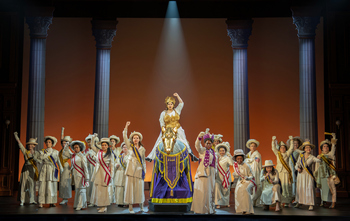
Suffs was a slang term for the women engaged in the American women's suffrage movement. While that struggle lasted over 70 years, Suffs focuses on its final years, 1913 through the ratification of the 18th amendment to the United States Constitution in 1920, granting American women the right to vote in all elections. This victory took seventy-two years from the Seneca Falls convention setting women's suffrage as a goal. In 1913, Carrie Chapman Catt is in her twentieth year as president of the National American Women's Suffrage Association (NAWSA), formed in 1890. Their approach was to remain ladylike, gently urging the men who held power to "Let Mother Vote." The NAWSA has been conducting state-by-state campaigns to gain the right for women to vote at the state level. By 1913 eight of the 48 states in the Union, all in the American west, have done so. Alice Paul, an activist for women's rights with a PhD in sociology, feels the NAWSA is too slow and too polite. Paul founds the National Women's Party (NWP) to "Finish the Job," determined to push President Woodrow Wilson out of office if he does not promote a constitutional amendment extending voting rights to women. The NWP's tactics include attention-grabbing marches and protests like the one up Pennsylvania Avenue led by a suffragist on horseback wearing a Nordic warrior's helmet; a silent vigil in front of the White House, boldly declaring "The Youth Are at the Gate"; and, when suffragists are arrested, holding a hunger strike in prison. Suffs depicts Paul's machinations with her inner circle of NWP associates Lucy Burns, Inez Milholland, and Doris Stevens, her ongoing conflict with Catt over their disparate strategies, and her persistent efforts to pressure Wilson into taking action. In a parallel plot line, African American journalist and activist Ida B. Wells refuses to work with the NAWSA or the NWP until they give Black women equal stature in the movement, a step Paul wants to take but cannot do without losing the support of southern white women. Wells' erupts furiously at the notion that she and other Black women have to "wait your turn." Wells' friend and fellow activist Mary Church Terrell (a charter member of the NAACP in 1909) is more amenable to joining with overwhelmingly white women's suffrage organizations, viewing their work as an insufficient but necessary step toward achieving their long-term goals. Taub's book is smart, witty, and clear, making it easy to follow the movement's progress toward achieving its goal, illuminating individuals and events that were given too little notice in the history taught to most of us. Being better informed about the building blocks on which our nation moved toward increased human rights is important in itself, but at a historical moment when many among us are seeking ways to change the current course our history is taking, this story is profoundly inspiring. It reminds us that change has never been easy and has only occurred through the perseverance of brave and deeply committed individuals willing to work with others who shared their dreams. Lest this sound pedantic, Suffs is laden with frequent daubs of humor and engaging characters who reveal their hearts as well as their convictions. It is, from start to finish, a first-class entertainment. Taub's score contains lilting melodies in a wide range of musical styles draw from both early 20th century and musical theatre motifs. Moreover, her lyrics contribute to the totality of the show as they make points and advance action. For a show with serious intentions, some of its best song are quite comical. These include "If We Were Married," a dig on the third class status assigned to wives at that time (and for a long time after), "Ladies," about Wilson's condescending ideas about managing the uppity women banging at his door, and the wonderful showstopper "Great American Bitch," a buoyant celebration of women who say what they mean, ask for what they want, and demand to be treated as equals to men. The potent song "This Girl" reveals the threat one generation feels (in this case Carrie Chapman Catt) when a new generation of leaders rises (Alice Paul), after the same aims but with new tactics and behaviors that seem to discredit the old ways. The show's final song, "Keep Marching," provides a rousing and inspirational. Leigh Silverman, the Suffs' director on Broadway, repeats that assignment for the tour and keeps the production fluidly moving. She delivers a long narrative that never falters and creates evocative stage imagery, some of which make stirring use of Lap Chi Chu's lighting design. Suffs is many wonderful things, but it is not a dance show, with Mayte Natalio's choreography primarily concerned with precisely coordinated assemblies and marches. Paul Tazewell's costume designs are terrific, containing the flourishes and frills of early 20th century apparel, with superb samples of the white dresses commonly worn by women at suffragist events. Every member of the touring company cast is terrific, including Annalese Fusaro stepping into the role of Lucy Burns usually played by Gwynne Wood. The central figure throughout is Alice Paul, and Maya Keleher gives a bravura performance, conveying the guts, powers of persuasion, and loyalty of a person whose commitment to her cause changed America for the better. Keleher has a charisma that makes her Alice Paul a natural leader. Marya Grandy is excellent as Carrie Chapman Catt, also strongly committed to the cause but unable to accept new ways of waging the fight she has long been fighting. This comes out at first as prickliness but is shown to be a defensive posture in Grandy's chilling delivery of "This Girl." Danyel Fulton nearly tears the roof off the Orpheum with her forceful delivery of "Wait My Turn," and throughout the show her Ida B. Wells is the voice of those for whom the fight for women's equality is not enough. Other standouts include Trisha Jeffreys as civil rights leader Mary Church Terrell, Monica Tulia Ramirez as the flamboyant suffragist Inez Milholland, Joyce Meimei Zheng as firebrand unionist Ruza Wenclawska, Livvy Marcus as Great Plains-bred suffragist Doris Stevens, Jenny Ashman portraying Woodrow Wilson as a shifty political creature, and Brandi Porter as Dudley Malone, an appointee under Wilson who acts with integrity. By the way, while Suffs includes only a few male characters, all the roles are performed by women. Suffs is an old-fashioned musical in that it makes no effort to insert current sounds of rock, rap, salsa, or other modes to appeal to today's musical appetites, but the music Taub has endowed with is perfectly suited to telling this story. The show doesn't break any ground in reconstructing the form of musical theatre, but draws on established modes to deliver a story with vibrance, high spirits, and clarity. Along those lines, it is the first time in a long time that I could discern every word in the songs without straining, which is a credit to sound designer Jason Crystal as well as the forthrightness of its presentation. Moreover, the story that Suffs tells couldn't be any timelier as a lesson on the sources of one of the freedoms we enjoy today and the struggle that brought that freedom to fruition. It tells us not to take our liberties for granted but, as the show concludes, to "Keep Marching." Suffs runs through April 12, 2026, at the Orpheum Theatre, 910 Hennepin Avenue, Minneapolis MN. For tickets and information, please call 612-339-7007 or visit hennepinarts.org. For information on the tour, visit suffsmusical.com. Book, Music and Lyrics: Shaina Taub; Director: Leigh Silverman; Choreography: Mayte Natalio; Music Supervision: Andrea Grody; Original Broadway Scenic Design: Riccardo Hernandez; Tour Scenic Design: Christine Peters; Costume Design: Paul Tazewell; Lighting Design: Lap Chi Chu; Sound Design: Jason Crystal; Wig and Hair Design: Charles G. LaPointe; Makeup Design: Joe Dulude II; Orchestrations: Michael Starobin; Vocal Arrangements: Shania Taub and Andrea Grody; Incidental Music Arrangements: Shaina Taub, Andrea Grody, and Michael Starobin; Music Director: Dani Lee Hutch; Music Coordinator: Kristy Norter; Associate Director: Lori Elizabeth Parquet; Associate Choreographer: Hawley Goud; Production Stage Manager: Stacy N. Taylor; Casting: The Telsey Office, Rachel Hoffman CSA. Cast: Jenny Ashman (President Woodrow Wilson), Abigail Aziz (principal cover)/ Anna Bakun (Speaker of the House/ensemble),Ariana Burks (principal cover), Tami Dahbura (Mollie Hay), Danyel Fulton (Ida B. Wells), Annalese Fusaro (swing), Marya Grandy (Carrie Chapman Catt), Marissa Hecker (Dr. White/Mailman/ensemble), Trisha Jeffrey (Mary Church Terrell), Maya Keleher (Alice Paul), Amanda K. Lopez (swing), Livvy Marcus (Doris Stevens), Merrill Peiffer (swing), Victoria Pekel (Phyllis Terrell/Robin), Brandi Porter (Dudley Malone), Monica Tulia Ramirez (Inez Milholland), Jenna Lea Rosen (Major Sylvester/Senator Burn/ensemble), Gretchen Shope (Mrs. Herndon/ensemble), Laura Stracko (Alva Belmont / Phoebe Burn), Gwynne Wood (Lucy Burns), Joyce Meimei Zheng (Ruza Wenclawska). |