|
Regional Reviews: Minneapolis/St. Paul The Jungle Also see Arty's reviews of The Boy Who Cried, HMong Futures: The Future of Us and The Postman's Daughter
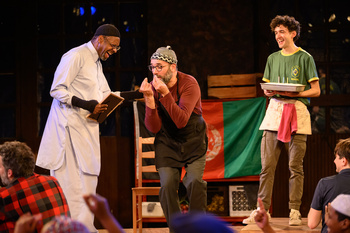
The Jungle is based on a real-life refugee camp dubbed the Calais Jungle. It existed between March 2015 and November 2016 in Calais, France, perched on the shore of the English Channel with a view of the White Cliffs of Dover standing guard over Great Britain, the hopeful destination of more than 8,000, at its peak, refugees from Sudan, Eritrea, Syria, Afghanistan, Turkey, Libya, Palestine, Iraq, Somalia, and more. The camp was not created by the United Nations or other international relief organization, but sprung up through the will of its inhabitants, an improvised tent city that became a world onto itself until the French authorities decided it posed a danger to public safety. It is thought that the camp's name was derived from the Pashto word "dzjangal" which means forest or woods, but, as the play depicts, its regression into "jungle" seemed inevitable, given the conditions. The site, occupying about 1.5 square miles, was a landfill designated a "Seveso Zone," which is a European Union term for sites containing large quantities of dangerous substances. It is near the French terminus of the Chunnel, the tunnel under the English Channel connecting France and England. Those who filed for asylum in France might receive temporary legal status but without any subsidy to help them live until their asylum case was resolved. Many in the Calais Jungle hoped to stow away on trucks bound for England, where services and tolerance for refugees was thought to be better than elsewhere in Europe. But the United Kingdom was in the throes of the Brexit campaign and, with Teresa May then the nation's home secretary, putting brakes on the influx of refugees from Africa and the Middle East, leaving those encamped at the Jungle in a state of limbo. We learn some of these facts in the course of the play, which runs 175 minutes divided by an intermission, but mostly we learn about the people drawn to leave their homelands, risk their lives through treacherous transit, and live on fumes of hope that they will make this last leg of their journey toward safety and realize dreams of a better future. Within the Jungle, enclaves based on nationality emerged. These are mapped out like a map of the world, referencing Afghanistan, Somalia, or Syria as if those ragged neighborhoods represented the entire nation. Within those neighborhoods, enterprising people use found bits of building materials to set up stores, masques, churches, hair salons, schools–there were an estimated 500 unaccompanied children in the Jungle–and a restaurant operated by Salar (Mohamed Yabdri), an Afghani, that actually was reviewed for its culinary finesse in the Times of London. Salar's restaurant is a neutral ground where leaders of each of the neighborhoods converge to address problems, though if there are unresolved disputes, Salar, as proprietor, pulls rank. A youth who works for Salar, Norullah (Ahmad Maher), tires of being called a "boy" and declares himself "a restaurant man." Later, tired of feeling cornered by conflicts with the boys from other neighborhoods, he acquires a pistol. Mohammed (Bruce A. Young), leader of the Somalis, strikes a calm, diplomatic tone, though never at the expense of his people. Helene (Comfort Dolo) is Eritrean and leads a church where she tries to guide her people to find a bright side in the blight. Okot (Abdoul Manaf-Kondo) is a sullen youth from Darfur who has been through hell and wants desperately to get to the United Kingdom. There are others, most notably Safi (Tony Larkin), a philosophical Syrian who has taken on the role of peacemaker among the factions, though the stress is wearing him thin. Safi acts as our guide to the Jungle. Then there are the British idealists who have come to help or to escape their life back home, or both. All of them are white. Derek (Eric Staves) sees himself capable of setting up a democratic structure in the Jungle; Paula (Cheryl "Cheza" Willis) is a dragonslayer who reserves all her kindness for the camp's many children; naïve Beth (Sophina Saggau), though scarcely older than the camp's youths, sets up a school for them and takes a special interest in helping Okot; Boxer (Jim Lichtscheidl) is a bit of a clown with a drinking problem who admits that he is there to dodge paying alimony; and Sam (Alex Mitchell), is just out of Eaton and bursting with unearned confidence. It is he who draws up the map of the Jungle's enclaves, and who clandestinely negotiates with a French agent named Henri (Paul LaNave) to reduce the impact of their government's plans to raze part of the Jungle. Every one of the actors named above, and those I have not named in the cast of 19, are brilliant, melding into their roles with utter authenticity beyond anything I can recall in six decades of theatregoing. Joe Stanley's set consists primarily of a pair of platforms, with the audience circled around the perimeter, just a few rows deep. Zamora Simmons' costumes capture the reality of each character and could not be improved upon. Marcus Dilliard's lighting modulates with the narrative, and C. Andrew Mayer's sound design augments the sense of being present in this grim, but not without hope, place. Robert Lehmann and Aryaman Rexer-Joshi perform music throughout the show that unobtrusively connect the characters to the home they carry in their hearts. Fights under the Jungle's conditions are inevitable, and are adroitly devised by fight choreographer Aaron Preusse. Kudos also to prop designer Abbee Warmboe, who makes every slight detail of this production ring true. About the languages spoken in the play: Most of the dialogue is in English, but there are times when characters speak in their home language. At times, when it fits the occasion, their words are repeated in English, but in all cases Mixed Blood has two large screens where all of the dialogue can be read, in English. These are mounted on different sides of the auditorium, so at least one should be visible to everyone in the audience. Playwrights Robertson and Murphy were themselves at the Calais Jungle as volunteers, where they set up a theater called Good Chance Theater. The Jungle bears witness to their observations. They used fictitious names and, one supposes, took dramatic liberties, but that does not undermine the feeling that what we see on stage is a slice of something very real. I have never been to a refugee camp, and thus cannot say from experience that the words spoken and the acts committed in The Jungle ring true. Yet, there is something woven into this work that assures me that they do. The play begins close to the story's end, with the Jungle on the brink of demolition, before bringing us back in time to tell the story from its beginning. Thus, we know right away how this ends, even if we missed the story when it had its moment in the news cycle ten years ago. And yet, after nearly three hours, I was loathe to have the play end. These people are so thoroughly animated and vibrant, and so deserving of a chance in life, that I hoped that somehow history could be altered by the force of artistry and passion I had witnessed, and the ending would change. But, sadly, the history has been recorded and cannot be undone. We can only hope that telling stories like The Jungle, and taking them into our hearts, can lead to a brighter future. The Jungle runs through May 3, 2026, at Mixed Blood Theatre, 1501 S. Fourth Street, Minneapolis MN. For tickets and information, please call 612-338-6131or visit mixedblood.com. Playwrights: Joe Robertson and Joe Murphy; Director: Mark Valdez; Set Design: Joe Stanley; Costume Design: Zamora Simmons; Lighting Design: Marcus Dilliard; Sound Design: C. Andrew Mayer; Props Design: Abbe Warmboe; Dialect Coach: Isa Condo-Olvera; Fight Choreographer: Aaron Preusse; Afghan Cultural Consultant: Mehran Sidiqui; Sudanese Cultural Consultant: Julia Kojo; Production Manager: Jessica Goldade Swanson; Stage Managers: Kenji Shoemaker, Stacy McIntosh; Assistant Stage Manager: Austin Schoenfelder. Cast: Nuradin Abdulahi (Omar), Avi Aharoni (Ali), Yassir Ali (Omid), Leor Benjamin (Maz), Layal Boe-Farag (Little Amal Wed., Fri., Sun), Comfort Dolo (Helene), Mila Ekisola (Little Amal Tues, Thurs., Sat.), Paul LaNave (Henri/ CRS Officer), Tony Larkin (Safi), Jim Lichtscheidl (Boxer), Ahmad Maher (Norullah), Abdoul Manaf-Kondo (Okot), Alex Mitchell (Sam), Sabrin Nur (Yasin), Sophina Saggau (Beth), Eric Staves (Derek/Guard), Cheryl "Cheza" Willis (Paula), Mohamed Yabdri (Salar), Bruce A. Young (Mohammed). Musicians: Robert Lehmann, Aryaman Rexer-Joshi. |