|
Regional Reviews: Minneapolis/St. Paul The Boy Who Cried Also see Arty's reviews of The Jungle, HMong Futures: The Future of Us and The Postman's Daughter
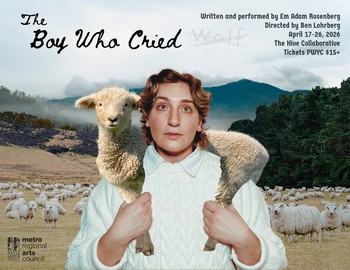
Twin Cities actor Em Adam Rosenberg has used this ancient story as the jumping off point for their first one-person show, The Boy Who Cried, mounted in its world premiere in the very intimate Hive Collaborative. The word "wolf" isn't in the title, as the boy's cries go beyond playing a prank. In fact, in this variation, the shepherd boy does not play pranks at all, but is a victim of the uncertainty of his vision, and of the predator's ability to show themself to the boy but conceal himself from all others. The play, two acts running a combined 75 minutes with an intermission between, is a showcase opportunity for Rosenberg to show themself as an engrossing storyteller, a spry comic actor, and a seeker of inner truth. In all three pursuits, they succeed splendidly. Rosenberg's versatility has allowed us to see them in a wide range of roles that span centuries, continents, and genders; think, for example, of Treasure Island, Whoa, Nellie! The Outlaw King of the Wild Middle West, Bernhardt/Hamlet, Top Girls and Romeo and Juliet. This time out I have a feeling that the actor has travelled only a short distance to present, in the guise of a shepherd boy, an internal journey of self-discovery. The play opens in a comedic mode, as the shepherd boy enters in stealthy steps, shrouded in a wolf's coat. At the center of the stage, the boy rises up and emits a ferocious growl, then drops the wolf's coat, giggles, and asks us, "Did I scare you?" Well, there he is, the shepherd boy crying wolf. He stands up on a straight-back chair, the only scenic element on the otherwise bare stage, and continues in this comedic vein. He calls the sheep (making it clear that we, the audience, are cast in the role of sheep) to order and goes over the rules of the pasture, a funny bit calling to mind the wit of Bob Newhart. There is some well-run audience interaction, and when he takes the flocks' attendance, forthcoming audience members are happy to respond to the name of a sheep with a "baa." There are some bits about sheep shenanigans, and a lovely piece about the shepherd boy's heavy crush on a neighbor girl. This detours into his fantasizing about what a beautiful wedding they will have, not being concerned with his awareness that boys aren't supposed to be interested in such things. When the neighbor girl pays him a visit in the pasture to deliver a garlic clove, which will prevent the sheep from having worms, the boy works hard to present a masculine veneer in response to her flirtatious overtures. There is also a courtroom scene involving sheep who fail to follow the instructions presented by the boy, which is played with the exaggerated style of burlesque comedy. And, yes, there are cries of "Wolf!" There are three cries, though none are intentional ruses. The first time the boy's mother appears and chastises him for bothering her needlessly. The second time the mother sends the boy's annoying younger brother to find out if the alarm is real this time. The third time–well, that's when an upheaval occurs that ends the first act with the boy running into the woods, screaming "I am no shepherd!" The second act takes place twenty years later and has a far darker tone. The boy–who may or may not have become transformed into a wolf, or become partly a wolf, or merely imagines himself to be transformed–has been searching for the wolf all these years, driven by an imperative sense that only confronting the wolf will make things right. The younger brother shows up, begging his older brother, the former shepherd, to give up his crusade against the wolf. But the shepherd must find and face the wolf and all that represents. He cannot step away, not yet. Though there is no set, aside from that one chair, the show has brilliant lighting, designed by technicians Cassidy Aickin and Tracy Joe, that changes the space from day to night, from uplifting to brooding, and even displays an aurora borealis. Rosenberg appears in outfits that seem like denim street clothes, the only adjustment being a change in the second act from short pants to long pants, the boy now having grown and forsaken short pants. Rosenberg performs effortlessly (or makes it seem so) throughout The Boy Who Cried, whether it is in the delivery of cheeky comedy, playing both parts in a sketch between the shepherd and the neighbor girl, or in describing the unearthly mix of terror and pleasure when describing his encounter with the wolf. The tone sometimes changes quickly, yet without ever feeling abrupt, and I imagine director Ben Lohrberg had a big hand in assuring that the piece is so well knit. At play's end, (spoiler alert), the shepherd boy has resolved his crisis of identity and the misalignment between his perceptions and the perceptions of those who judge such things. Like a fable–though this one veers far from anything Aesop told–the play ends with a moral. The moral is not presented in a declarative way, but is implied in the shepherd boy's discovery and acceptance of his own truth. Rosenberg will be moving on from this play to appear in Theatre Latté Da's upcoming production of My Antonia, followed by an entry in the MN Fringe Festival. Hopefully, they will find opportunities to work The Boy Who Cried into gaps that occur in their schedule in order to allow it to reach a wider audience. This inventive work entertains, intrigues, and reaches out to affect its audience in a pleasingly personal way. The Boy Who Cried continues through April 26. 2026 at The Hive Collaborative, Hamline Ave. N., St. Paul, MN. For tickets and other information go to thehivecollaborativemn.com. Playwright: Em Adam Rosenberg; Director: Ben Lohrberg; Lighting Design: Cassidy Aickin and Tracy Joe. Cast: Em Adam Rosenberg (Sheperd/Neighbor Girl/Mother/Little Brother/Wolf/White Wolf/others). |