|
Regional Reviews: Minneapolis/St. Paul Promise of America Also see Arty's reviews of Joan of Arc and Harry Potter and the Cursed Child
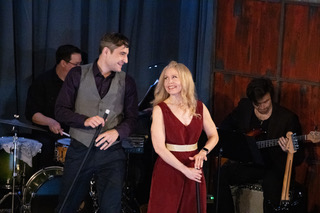
Berg and Six Points' Producing Artistic Director Barbara Brooks co-created Promise of America based on a concept that originated with Brooks as an online entertainment during COVID. She also wrote the book for the show, which consists of the four performers taking turns introducing each song and/or composer, with fun facts about the artist's career or the origin of a song. Sometimes those introductions are paired, as when two songs by the same composer (the Gershwins, Carole King), or two from the same musical (West Side Story, Fiddler on the Roof) are on deck. If you noticed I have already, uncharacteristically, used two baseball metaphors in this review, I may have been effected by the fact that the oldest song in the show, going back to 1905, is "Take Me Out to the Ballgame" (yes, that was written by a pair of Jews, Albert Von Tilzer and Jack Norworth–who knew?). That comes a few numbers into the show. The production opens with "There's No Business Like Show Business," a natural way to kick things off, which slides into a medley of other Irving Berlin songs: "Puttin' on the Ritz," "Blue Skies," "Cheek to Cheek," "White Christmas," and "God Bless America." Berlin was born in 1888 in Russia and was named Israel Beilin. When he was five his family immigrated to America to escape pogroms against the Jews. They arrived hopeful that the promise of freedom and opportunity proffered to the refugees fleeing Europe on steamers would be realized, and eager to do their part to make America an ever widening and prospering haven. This classic immigrant story still plays out today, though with barriers today not imposed on Berlin's family–nor on mine. Promise of America offers this kind of background information, putting the work of Jewish-American composers into an historical and cultural context. This is more the case early on. The Berlin medley is followed by "My Yiddishe Momme" by Lew Pollack and Jack Yellen. That song touches not only on a Jewish immigrant's longing for a mother left behind across the sea, but addresses the tension between hanging on to old traditions and assimilating into a new homeland, just as our most recent arrivals, be they from Somalia, Burma, or El Salvador, must face. Benjamin Dutcher's tenderly emotive rendition of this song is one of the highlights of the show. As Promise of America progresses, the introductory comments less frequently focus on the song's reflection of Jewish life or values, and more often focus on an example of a new taste in popular music, as in a shift from the sounds of golden age Broadway shows to the pop music coming out of New York's famous Brill Building, with songs like "Love Potion #9," "Be My Baby," and "Chapel of Love" written by Jewish tunesmiths, but not particularly borne of a Jewish sound or cultural trait. The first act ends with the mention of Neil Diamond, another alumnus of the Brill Building, and a near-obligatory sing-along of "Sweet Caroline," which, honestly, is irresistible, especially with Randy Schmeling effusively leading the audience on. The second act opens with more Neil Diamond, but shifts from 1969's cheery "Sweet Caroline" to 1980's "America," a celebration of America's immigrant roots, both profound and joyful. Diamond wrote "America" for the remake of the film The Jazz Singer, in which he starred, but has said the song was inspired his Jewish immigrant grandmother. After this powerful second act opener, we race through more songs–well, not really race, but with so much great music it feels that we, by necessity, have to bid farewell to each composer too soon. We meet singer-songwriters like Paul Simon, Leonard Cohen, Billy Joel, and Carole King. We drop in on Bacharach and David, Stephen Sondheim (only one song, though earlier we did hear his lyrics from West Side Story), and Marvin Hamlisch with Marilyn and Alan Bergman, who contribute "The Way We Were," masterfully sung by Kim Kivens. An anecdote about Arthur Laurents, who wrote the screenplay for The Way We Were in which he insisted that it was "high time a movie feature a Jewish actress in the lead role," came as a surprise. Hadn't that same Jewish actress already starred, to great acclaim, in Funny Girl? For that matter, Promise of America has nothing from Funny Girl ("People"? "Don't Rain on My Parade?"). But again, so much great music and too little time. If it were up to me I would have shoe-horned in Steve Goodman's "City of New Orleans" (a hit for Arlo Guthrie, also Jewish) but alas, no. Stepping into the 21st century, we hear from Wicked composer Steven Schwartz, singer-songwriter Regina Spektor, and rap musician Nissim Black, who was born in Seattle into his grandfather's Muslim faith, turned to Christianity at age 14, and at age 22 began to adopt Judaism, fully converting as an Orthodox Jew a few years later. Sometimes the journey Jews take is across the sea, sometimes it is within the heart. The show saves the big kahuna among contemporary Jewish songwriters, Robert Zimmerman, aka Bob Dylan, for last, closing with "Forever Young," a lovely benediction to send the audience out feeling not only entertained, but also inspired. The four singers–three of whom have long been well known to me as top-notch theatre actors, and one of whom, Imani Harris, is a delightful new (to me) discovery)–are well chosen not only as singers but also actors. Working with the show's director, Shelli Place, the songs are not merely sung, but brought to life as stories, with their interpreters using their faces and bodies, along with their voices, to deliver each song's message. Place also choreographed the show, and though there are only four performers, and the stage at Six Point's theater is rather small, there are nice dance sequences in the opening Irving Berlin medley, the Fiddler on the Roof medley, a medley of Brill Building songs, Billy Joel's "Uptown Girl," and Leonard Cohen's "Dance Me to the End of Love." There is no dead weight in Promise of America. Though I would wish to have heard some other songs–and in some cases, full versions of songs that are truncated, such as "Can't Help Loving Dat Man"–there is nothing I would leave out. Among the most satisfying not already mentioned are Imani Harris' "I've Got Rhythm," Harris and Benjamin Dutcher's "I'll Never Fall in Love Again," Randy Schmeling leading a choral rendition of Leonard Cohen's "Hallelujah," Harris and Kim Kivens' evocative "For Good" from Wicked, and Kim Kivens, whose light shines bright through the entire show, doing "Send in the Clowns," "The Way We Were," and a heart-tugging "Over the Rainbow." Brady Whitcomb's scenic design, A. Emily Heaney's costumes, and Todd Reemtsma's lighting design are all modest, in keeping with the tenor of the show. Reemtsma does have a merry trick up his sleeve at one point, which I won't spoil for you–you'll know it when you see it. Promise of America is nothing more than its subtitle claims: "A new celebration of Jewish American Song." I might quibble that, while the songs are all by Jewish-American composers and lyricists, they are, every one, American songs that speak to something in American history, culture, fears, pleasures, or dreams. This collection of songs attests to the strength that bringing together all nationalities, all races, and all religions has always brought to these United States. Promise of America runs through May 17, 2026, at Six Points Theater, Highland Park Community Center, 1978 Ford Parkway, Saint Paul MN. For tickets and information, please call 651-647-4315 or visit www.sixpointstheater.org. Co-Created by: Barbara Brooks and Raymond Berg; Concept and Book: Barbara Brooks; Director and Choreographer: Shelli Place; Musical Director and Arrangements: Raymond Berg; Scenic Design and Technical Director: Bradley Whitcomb; Costume Design: A. Emily Heaney; Lighting Design: Todd Reemtsma; Stage Manager: Miranda Shunkwiler; Assistant Stage Manager: Kendall Roland Cast: Benjamin Dutcher, Imani Harris, Kim Kivens, Randy Schmeling. Musicians: Raymond Berg (keyboard), Joey Van Phillips (drums and percussion), Christian Wheeler (guitar, bass, mandolin). |