|
Regional Reviews: Phoenix Jitney Also see Gil's reviews of The Secret Garden, Blithe Spirit, The Mousetrap, The Barricade Boys: Broadway at the Movies, Cheyenne Jackson's Midlife Torso Tour
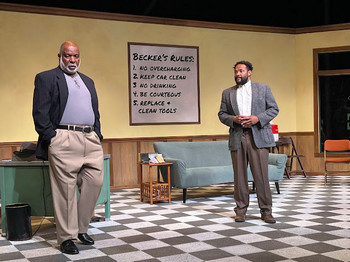
Set in 1977 in in Pittsburgh's Hill District, the plot follows a group of drivers who work for Jim Becker, the station's proud and disciplined owner who struggles to keep both his business and his personal life intact. Around him are a group of drivers with their own problems and dreams, including Youngblood, who wants a better life for his family, Turnbo, who gossips like an old woman, and Fielding, who has fallen on hard times. With the threat of the city's plans to demolish the station and all of the stores on the block, Becker must also confront the return of his estranged son from prison, while personal conflicts and unresolved resentments rise to the surface, leading to moments of both humor and heartbreak. Jitney, which premiered in 1982 and was considerably rewritten for productions from 1996 forward, is the first play August Wilson wrote for what would become his monumental Century Cycle of ten plays, each depicting African American life in a different decade of the 20th century, reflecting social change, community struggles, and personal histories. Black Theatre Troupe is one of only a number of theatre companies that have presented all plays in the cycle. Jitney is infused with themes that echo throughout the entire cycle, including generational conflict, economic survival, pride, and the search for respect in a society stacked against its characters. Jitney also focuses on taking responsibility for things one has done in the past. Wilson's writing here is naturalistic and conversational, filled with rhythmic dialogue and earthy humor that grows out of discussions that feel like regular daily banter between friends or co-workers with deeply rich and moving monologues that deepen the characters and their relationships with each other. The cast gives each character a distinct presence. Becker is portrayed with quiet authority and emotional restraint by Ken Love, while as Booster, his son, Rapheal Hamilton brings raw intensity and vulnerability to their fraught relationship. The scenes they share together, even when few words are spoken, crackle with electricity. The restless ambition that Jonathan Davis brings to Youngblood contrasts nicely with the fast-talking bravado and comic bluster of Eric L. Banks, which makes the busybody Turnbo an audience favorite. The gentle melancholy that Calvin Worthen instills in Fielding is deeply affecting, and the measured wisdom that Roosevelt Watts brings to Doub provides a steadying influence throughout the production. As Shealy, the quick-witted hustler, Jonah B. Taylor adds pops of humor with his charm, and as Rena, the lone female character, Kay B. Rose brings strength and clarity to her scenes, grounding her moments with Davis' Youngblood with emotion and authenticity. Dion Belcher is featured in a small role. Rachel Finley's direction allows the scenes to breathe and relationships to develop organically. There are, however, a few lengthy scene changes and some odd choices involving musical underscoring and the constant sound of a ticking clock that, especially during a few monologues, occasionally interrupts the forward momentum and pulls focus from Wilson's powerful language and intriguing characters. Tiana Torrilhon-Wood's simple but detailed set and period-appropriate costumes by Samuel Linn Davis beautifully capture the time and place, reinforcing the authenticity of the story and the characters. Jitney remains a vital and essential entry in August Wilson's Century Cycle. Despite minor pacing and sound design quibbles, The Black Theatre Troupe's production honors Wilson's legacy and stands as a compelling reminder of the enduring power of his stories and the communities they represent. Jitney runs through February 22, 2026, at The Black Theatre Troupe, Helen K. Mason Performing Arts Center, 1333 East Washington Street, Phoenix AZ. For tickets and information, please visit www.blacktheatretroupe.org or call 602-258-8129 Directed by Rachel Finley Cast: |