|
Regional Reviews: Minneapolis/St. Paul Louisa May Alcott's Little Women Also see Arty's reviews of The Bird Blind, The Boy Who Cried, The Jungle, HMong Futures: The Future of Us and The Postman's Daughter
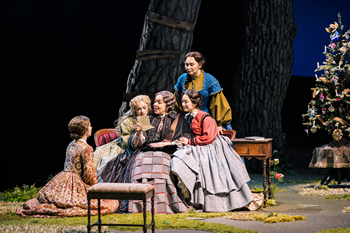
Gunderson's adaptation focuses primarily on Jo, but uses the character of author Louisa May Alcott to introduce the story and provide some meaningful background. Louisa, along with the other actors playing the family members they are based on, appears in the very beginning and at the end of each of the two acts. Because the audience is introduced to the play as a novel, it allows every character to produce some narration at opportune moments within the play. I appreciate that, despite the necessary cutting of various scenes and characters, we are treated to some of Alcott's original prose. Lee's scenic design blends the boundaries between nature and the March family's home in Concord, Massachusetts during the time of the Civil War. Grass carpets the thrust of the stage, with various furniture set pieces spread throughout. The set pieces remain anchored, allowing the action to move seamlessly from inside to outside. The staging, especially in the first half, takes full advantage of all areas with some fun transitions involving the March girls. The choice to place Beth's piano upstage with her back to the audience left me wanting to see her face more at times. I also wanted to see more of George Keller's Marmee in a heartfelt scene between Jo and Marmee staged all the way upstage left. But these are minor quibbles. The courtship scene between Meg (Stephanie Anne Bertumen) and John (Logan Lang) staged on a trunk downstage center is all hilarity and joy. Costume designer Ford keeps the colors vibrant and shows the necessary class distinction between the poor Marches and the rich Laurences next door. Whitaker's light design plays with the nuances of Lee's static scenic design, helping to paint a new picture in each swift scene change. As is appropriate to a family as musical as the Marches, it is the sound design and composition by Nielson that are the star elements of this production. The actors all appear to be wearing microphones, most likely necessary due to the numerous musical motifs seamlessly incorporated within transitions, in the background, or embedded into the scenes. The story of the March girls is an incredibly touching, moving story, with hilarious and mournful elements. The sound design in the sequence in the first act where shy Beth, played by Mae Heinecke, first visits Mr. Laurence's house to play his piano, effortlessly enhances the brief moment, bringing myself and, judging by the sniffs, many audience members, to tears. The action of this production centers entirely on the March sisters, and each actor brings the qualities we attribute to tomboy Jo, beautiful Meg, tenderhearted Beth, and precocious Amy, played by Audrey Parker. Their warm comradery is infectious, and Daniel Petzold lends all his boyish enthusiasm to neighbor and close friend Laurie. There is not a weak link in the cast, though due to the focus of the adaptation we see very little of any of the other men, particularly Mr. Laurence and Mr. March, both played by Bill McCallum, who lends what gravitas he can to what amounts to a cameo role. I cannot recommend this production highly enough. Alcott's themes of independence, hope, and community resonate as strongly today as I'm sure they did 150 years ago. I find the heartwarming and real relationships between the four sisters and the trials they undergo through the course of growing up as meaningful as when I first read the book. This is an enchanting, urgently joyful interpretation of Alcott's story. Louisa May Alcott's Little Women runs through June 21, 2026, at the Guthrie Theater, 818 South 2nd Street, Minneapolis MN. For tickets and information, please call 612-377-2224 or visit guthrietheater.org. |