|
Regional Reviews: Minneapolis/St. Paul The Most Happy Fella Also see Arty's reviews of Promise of America, Joan of Arc and Harry Potter and the Cursed Child
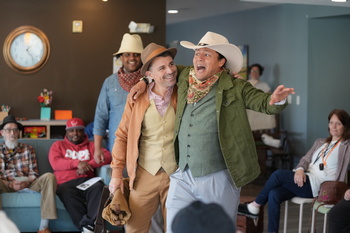
Ten Thousand Things pares down their offerings to the essential elements, performing with barely any set and neither lights nor electronic sound systems. A minimum number of actors, often doubling or tripling roles, reveal the heart of every story. In addition to performing for traditional, paying audiences, this stripped-down philosophy also allows the company to pack everything into a van and bring their shows to audiences that rarely, if ever, experience professional live theatre, in settings such as inner-city high schools, rehab programs, services for the homeless, neighborhood centers, adult education sites, and even prisons. I had the good fortune to see Most Happy Fella at MSS, a St. Paul-based non-profit organization that provides a host of services for adults with disabilities. The Most Happy Fella is based on a play by Sidney Howard called They Knew What They Wanted, winner of the Pulitzer Prize for Drama in 1925. At its heart it is the story of two people hoping for love to make their life complete, who go about seeking it in awkward, one might say desperate, ways. This unlikely pair come together in the setting of a grape vineyard in California's Napa Valley owned by Tony (Pedro Bayón), an aging, paunchy, and, by his sister Marie's (Norah Long) account, funny-looking Italian immigrant, beloved by his workers and his community, but lonely at heart. On a trip to San Francisco, Tony stops in a diner where a lovely young woman (Suzie Juul) serves him. Though he doesn't speak to her, he is rashly convinced that this woman will be the love of his life, the difference in their worlds and ages notwithstanding. Calling her "Rosabella," he leaves a piece of jewelry–his tie pin–and a note inviting her to correspond with him. Against all odds, this correspondence blossoms, even though "Rosabella" cannot remember seeing the man who left the note. When, after a couple of months, she sends him her photo and asks him to send his in return, he panics, fearing that once she sees what he looks like, he'll have lost her. Desperate, he asks his handsome foreman, Joe (Sasha Andreev), who just announced that he was quitting the vineyard, for a photo to remember him by, and sends that one in place of his own. It is easy to see that with this deception, the path of love will not go smoothly. Loesser's book, drawing closely on Howard's play, finds a resolution that shows sensitivity, feels authentic, and leaves the audience with renewed faith in the strength of love and forgiveness. The seven-member cast is perfect. Bayón is made-to-order as Tony: gregarious, good-hearted, but hard on himself. I have seen Bayón give strong performances before, but didn't recall what a beautiful singing voice he has. I will never forget it now after hearing him sing operatic numbers like "Rosabella," "How Beautiful the Days," and "My Heart Is So Full of You," and spread joy in the rousing title song. He tenderly expresses Tony's hopes as well as the fears that have held him back for so long. I did remember that Juul sings beautifully, and as Rosabella she has the opportunity to display it in "Somebody Somewhere," "How Beautiful the Days," "Warm All Over," and "My Heart Is So Full of You." She brings a wide range of changing feelings to her character, from the wild hope that a stranger who left her his tie pin at the diner might bring her happiness, to fury at being deceived, to a growing resignation toward her new life, and the emergence of genuine love. Juul and Bayón sing together beautifully, and have fun with the charming duet, "Happy to Make Your Acquaintance." Julia Diaz plays Cleo, Rosabella's friend and fellow waitress, who opens the show marvelously with "Ooh! My Feet," a comical ode to the drudgery of a waitperson's life ("bet you your life a waitress earns her pay."), performed with great physicality. The number is very funny, but Diaz also makes us understand the hard life that would drive her friend to trade it for a chance of happiness on a stranger's vineyard far from the life she knows. Diaz conveys Cleo's frank, no-nonsense approach to life but also her concern for her friend, especially when, to cheer his angry Rosabella up, Tony sends for her, offering Cleo a job gluing labels on the fruit crates. Diaz also brings gusto to what is probably Fella's liveliest production number that celebrates a connection made with hired hand Herman, played by Phinehas Bynum (delightful), when they discover they are both from Dallas, the "Big D," sung as: "big d, little a, double l, a, s." Andreev has the requisite handsome, well-built appeal to play Joe, along with a rich baritone for delivering the haunting "Joey, Joey, Joey." He manages to meld Joe's capacity to be sympathetic and tender with a tendency to be a heel, making both faces feel authentic. Long gives a rich performance as Marie, who devoted her life to caring for the brother she expected to always be alone, and now fears that she will be the one left alone. She and Bayón share a wistful moment in the lilting "Young People." The show has a couple of Italian-sounding ensemble numbers, "Abbondanza" and "Sposalizio," that bring a festive feel to the show and are adroitly staged by director Caitlin Lowans, who is Ten Thousand Things' artistic director, with "movement" credited to Kyle Weiler. Another ensemble piece, "Fresno Beauties," is festive, though with a hacienda rather than Italian flavor. It is interpolated with the brooding "Cold and Dead," sung by Juul and Andreev. The show's biggest hit in 1956 was "Standing on the Corner." Recorded by The Four Lads, it reached #3 on the Billboard Hot 100. The song has a great melody and jaunty lyrics, but with the opening line "Standing on the corner, watching all the girls go by," it is laden with 1950s sexism. To even things up a bit, Lowans changed one word in the final verse to "watching all the guys go by," and has a couple of female cast members join the three men singing on stage. This feels like fair play and reduces the prospect of the song tarnishing the show with an "ick" element. (Full disclosure: my family owned that Four Lads record and I have always loved it.) Lowans directs this production, which runs a bit over two hours, plus intermission, with the ingenuity and economy audiences have come to expect from Ten Thousand Things' work without sacrificing any of the show's heart. Weiler's movement contributions make great use of the small cast and minimal space, bringing comedic flair into some of the dance. Sonya Berlovitz's costume designs work wonderfully to establish characters, allowing slight changes to signify actors switching from one character to another, and using a change in the color of Rosabella's dress that matches her changing frame of mind. The Most Happy Fella is a musical with a lot of music, with recitative-like bridges connecting many of the songs. This is one of the reasons the show is often considered to verge on opera (putting it in the good company of shows like Candide and Sweeney Todd). As usual for a Ten Thousand Things show, music and other sound elements are provided by a sole music director, in this case, multi-talented Isabella Dawis. Dawis has support from several of the actors who contribute by playing instruments, which does enrich the sound of Loesser's lush melodies. Dialect coach Isa Condo-Olivera's fine work is especially notable when realizing that Cleo and Herman, sure enough, speak with the same variant of a Texas drawl. The Most Happy Fella was previously mounted by Ten Thousand Things in 2001, making it only the second musical the company took on. At that time, the company chose to restore a backstory about Joe from Howard's original play, in which he was a union organizer who traveled from farm to farm spurring underpaid farm hands to unionize. Loesser dropped that tangent and made Joe a drifter who avoids putting down roots and moves on when he gets restless. In 2001, and again in 2026, Ten Thousand Things tries to have it both ways, making him both an organizer and a drifter, but we see no evidence of Joe having done any union work at Tony's vineyard, nor of there even being a union; the reason he gives his boss for leaving is sheer restlessness (earnestly expressed in "Joey, Joey, Joey"), rather than his union work there being done and that its time to go where he is needed next. A few lines about low wages and capitalism feel awkwardly shoe-horned in. This one caveat aside, The Most Happy Fella is a triumph for Ten Thousand Things Theater, delivering a message of forgiveness through a compelling story, gorgeous music, and ace performances. About the title of the play, They Knew What They Wanted: it seems that they knew, but were at a loss to attain what they wanted. Like a fairy tale, but also like quite authentic human behaviors, they finally do get what they want and Tony realizes his claim to be "'the most happy fella' in the whole Napa Valley." The Most Happy Fella, a Ten Thousand Things Theater Company production, runs May 14 - February 17 at the Open Book, 1011 Washington Ave. S., Minneapolis; May 21 - May 24 at Hennepin Avenue United Methodist Church, 511 Groveland Ave., Minneapolis; May 28 - May 31 at the Capri Theatre, 2027 West Broadway Avenue, Minneapolis; and June 4 - June 7 at 825 Arts, 825 University Ave, St. Paul. Very limited seating remains for free community performances (donations appreciated). For tickets and information, please call 612-203-9502 or visit www.tenthousandthings.org. Book, Music, and Lyrics: Frank Loesser, based on Sidney Howard's play They Knew What They Wanted; Director: Caitlin Lowans; Music Director: Isabella Dawis; Costume Design: Sonya Berlovitz; Scenic Designer: Eli Sherlock; Movement: Kyle Weiler; Dialect Coach: Isa Condo-Olivera; Stage Manager: Kathryn Sam Houkom. Cast: Maje Adams (Clem, Postman, Pasquale, Doc), Sasha Andreev (Joe/Diner Manager/others), Pedro R. Bayón (Tony), Phinehas Bynum (Herman/others), Dominic Delong-Rodgers (understudy), Julia Diaz (Cleo/others), Suzie Juul (Rosabella/others), Sydney Lin (understudy), Norah Long (Marie/others). |