|
Regional Reviews: Minneapolis/St. Paul The Imaginary Invalid Also see Arty's reviews of The Most Happy Fella, Promise of America, Joan of Arc and Harry Potter and the Cursed Child
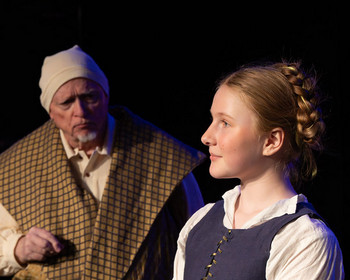
Molière wrote social satires, skewering various aspects of "modern" life in 17th century French society. The target of his wit in The Imaginary Invalid is the burgeoning medical profession and those who put their faith in the dubious knowledge and skills of physicians and apothecaries. The main character, Argan, is a middle-aged hypochondriacal man who takes pride in the number of maladies he suffers and the number of potions, poultices, and other prescriptions he consumes. At the same time, in common with views on health care today, he rants on about the difficulty in finding a good doctor, the high cost of his medications, and the fact that none of it seems to help. In Molière's day, physicians used trial and error strategies, unproven medications, and long-since discredited practices like bleeding-out and purges. As a new field, medicine was an effort to rise above reliance on prayer or superstition as the only paths to healing, but was subject to many pitfalls and pretenders. Molière depicts Argan as foolish in his enthusiasm for this new enterprise. By way of Argan's sensible brother, Beralde, the playwright presents a litany of arguments against doctors and medicines. The final scene depicts the examination required to become a physician as an utter travesty, affirming the play's notion that physicians of that time are charlatans whose primary expertise is knowing the Latin names for body parts and ailments. The actual plot in The Imaginary Invalid concerns Argan's plans to have his older daughter Angelique marry a doctor (the better to have one in the family), while she is in love with a musically inclined young man named Cleante, who intends to ask Argan for Angelique's hand. There are further complications involving Argan's second wife, Beline, who schemes to edge out Argan's children and inherit his wealth, while Beralde endeavors to talk sense into his brother regarding his daughter's happiness, his wife's avarice, and his obsession with his health–which appears to be fine–and frequent application of enemas, which becomes the butt of many jokes (oh, my!). The only one who seems to grasp the totality of it all is Argan's sharp-tongued maid, Toinette. Molière's humor is far more direct than, say, the comedies of Shakespeare, where jokes are often woven into wordplay and plot devices (such as mistaken or disguised identities). However well Molière's work played to the crowds in 17th century Paris–quite well, I guess, considering the renown they brought to the playwright–it comes across now as extremely silly. Which isn't to say that it can't be funny. But it does require some panache on the part of the actors in order to avoid wearing out its welcome. Here is where the Applause production yields scattered results, with some performances capturing the spirit Molière seems to invest in his characters, and others seeming to be out of tune. There are also points where timing is amiss, so that rather than the natural flow of conversation or the overlapping fray of arguments, a character's line is followed by a pause, slight but enough to convey the sense that actors are reciting their lines, rather than speaking as characters authentically engaged with one another. Thus, some scenes find the humor with actors playing in character while having conversations with other characters, and in other scenes we see actors just trying to be funny, which has the opposite effect. Fortunately, Shannon Kennedy, in the central role of Argan, portrays the title character as a full-bodied, authentically present, and extremely funny character, both in his delivery of the spoken lines, and in his physical bearing (keeping in mind those enemas). He establishes Argan's self-centeredness and his determination not to let anyone upset his view of the world, be it a daughter's duty to obey her father, his naïve belief that his wife adores him, or his obsession with the notion that his health is in shambles. Sage Green as Angelique, Andrea Eichers as Beline, Nora Persephone as a notary helping Argan to update his will, and Oracle as Angelique's beloved Cleante also have both timing and characterizations nailed down, and are able to mine the humor in their roles. Richard Divita, playing Beralde, has great timing in his harangue with Argan, but delivers it with a broad grin plastered on his face that makes it look as if he is watching the play rather than performing in it. As director of this production, Debbie Schneider wears multiple hats. The production benefits greatly from her well-conceived costume design coordinated in consultation with Ananda Frey, an expert on historic period attire. Schneider also coordinated the set pieces that, with just a few items, establish a sense of time and place. Schneider is most to be commended for taking a 353-year-old play written with specific satiric intent grounded in its era and turning it on end to make it feel relevant today. Staging the The Imaginary Invalid today sends an open invitation to its audience to draw parallels between the state of healthcare in 17th century Europe with our current healthcare system. Thankfully, the science behind the medical and pharmaceutical professions have made huge strides, with the ability to control, in some cases eliminate, once deadly diseases, and huge gains in life expectancy, paired with reduction in infant and maternal mortality. Of course, those gains have not been applied equally available around the world, and in some cases they are theoretically available but undermined by barriers posed by a profit-driven delivery system. Still, the advances are irrefutable and what were undoubtedly legitimate barbs tossed at physicians and apothecaries in Molière's day, today feels like thinly veiled sarcasm aimed at the constituencies that discredit modern medical science, refute the benefits of well-tested immunizations, and oppose effective strategies to manage public health as an infringement on personal freedom. Thus, The Imaginary Invalid today strikes targets that are just the opposite of those Molière set his sights on. If you, like me, have never had the occasion to experience Molière's acidic wit and dramatic flair in live performance, Applause Community Theatre is offering you an opportunity I encourage you to seize. If you are familiar with Molière, and particularly with The Imaginary Invalid, you may find it of interest to see how well the play's centuries old satire serves to lambast the current status of the medical profession, albeit making a 180-degree pivot. The Imaginary Invalid, an Applause Community Theatre production, runs through May 10, 2026, at The Hive Collaborative, Hamline Ave. N., St. Paul MN. For tickets and information, please visit www.act-mn.org. Playwright: Molière, adapted by Debbie Schneider and Connor Davis; Director: Debbie Schneider; Technical Director: Connor Davis; Music Composer: Bruce Bolon. Cast: Bruce Bolon (Dr. Purgon), Rowan Borton-Statz (Louison), Richard Divita (Beralde), Andrea Eichers (Beline), Sage Green (Angelique), Shannon Kennedy (Argan), Arthur Kirkland (Mr. Fleurant), Faith Martin (Toinette), Oracle (Cleante), Nora Persephone (Mademoiselle De Bonnefoi), Dustin Rupe (Thomas Diafoirus), Tom Sauer (Dr. Diafoirus). |